There is a specific kind of magic that happens when you pull a skein from the back of your stash that you haven’t touched in years, only to realize it holds the exact shade of sky you’ve been dreaming of. For this project, the decision wasn’t just about color; it was about the architecture of the light. I reached for a smooth cotton or cotton bamboo blend, drawn to the way the fiber holds a crisp stitch definition while still offering a soft, fluid drape. The goal was to mimic the iridescent shimmer of a Blue Morpho wing, requiring a yarn that wouldn’t hide the intricate scale work in fuzz, but would instead let the layered fans catch the light with every movement.
Yarn and Color Notes
The visual impact of this shawl relies heavily on the transition of hues. The pattern calls for a gradient that flows from pale sky blue down through turquoise and into deep cobalt. Using a mercerized cotton will give you the crispest definition for the fan ribs and butterfly veins, while a cotton bamboo blend will offer a softer, more romantic fall. It is crucial to avoid very fuzzy yarns, as the layered scale structure depends on visible stitch architecture to create that dimensional texture. The final result is a piece that feels intentional and sculptural, wrapping you in a spectrum of blues that feels both like a summer breeze and a midnight sky.
Project Overview
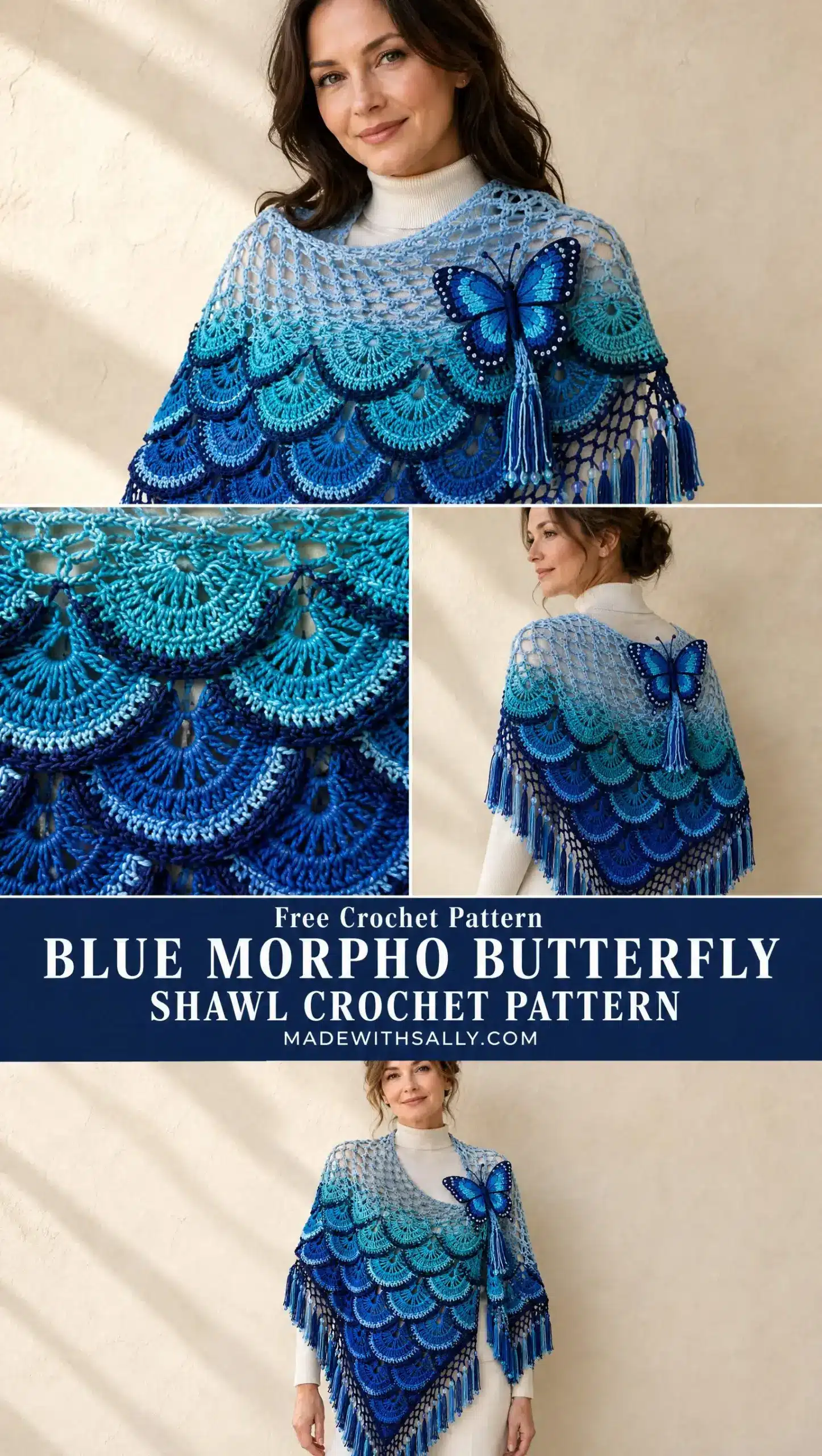
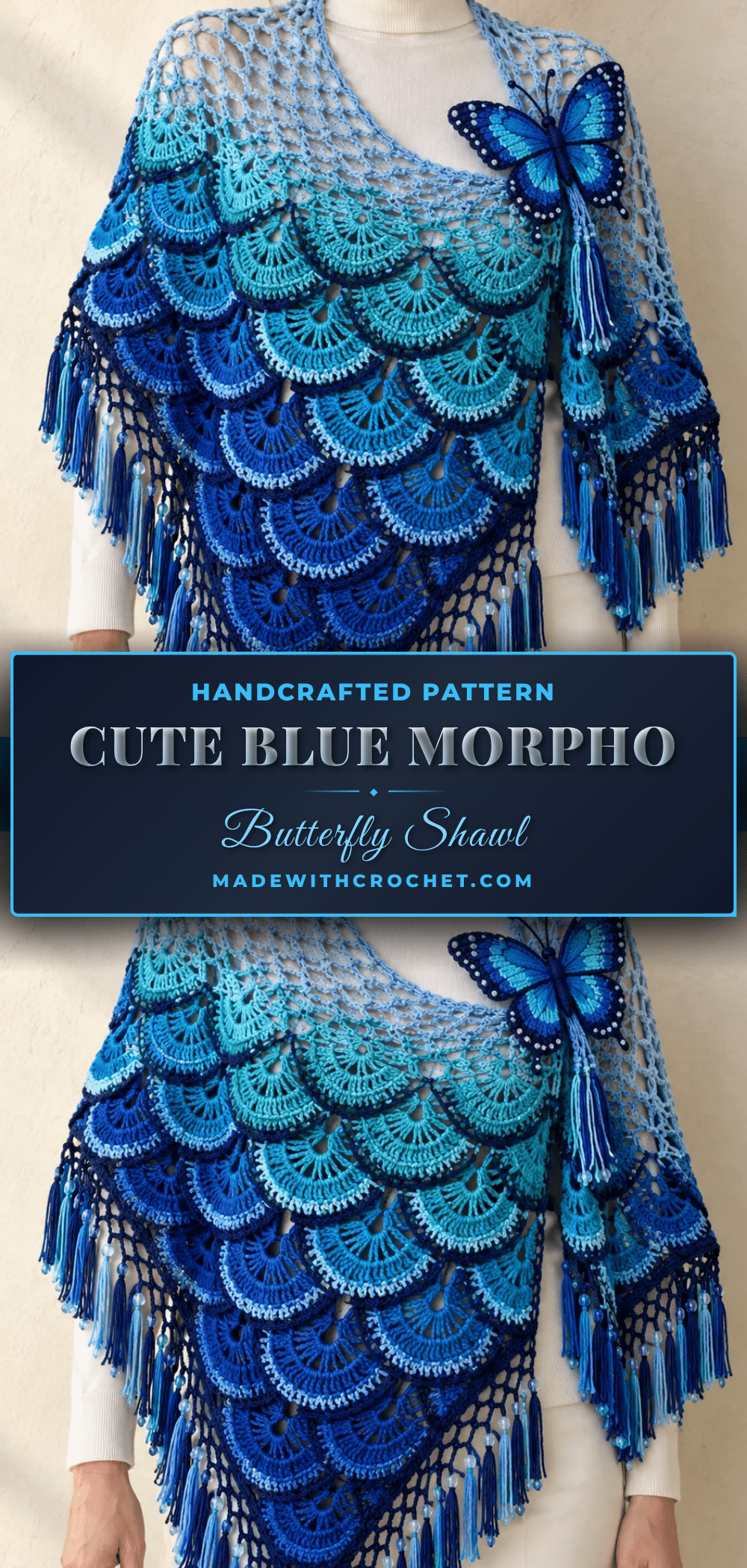
The Blue Morpho Butterfly Shawl is an intermediate to advanced crochet project that creates a full-size triangular shawl measuring approximately 175 to 185 centimeters across the wingspan and 82 to 88 centimeters deep, not including the fringe. The construction method is a top-down triangular mesh with joined-on scale motifs and a separate butterfly applique. The shawl begins at the center back neck and grows outward as an open triangular mesh. The upper section stays airy and pale blue, forming a delicate chain lace yoke across your shoulders. From the lower yoke downward, individual raised fan motifs are crocheted separately and then joined to selected mesh spaces in staggered rows. They overlap like the scales on a butterfly wing, creating that gorgeous dimensional texture. The final perimeter is stabilized with a navy mesh edging and finished with long mixed blue fringe. A sculptural four-wing butterfly is worked separately and sewn at the upper right chest as the closure accent.
Materials
- Yarn: Fingering to sport weight smooth cotton or cotton bamboo blend yarn. You will need a total of approximately 1,150 to 1,350 meters across five shades of blue.
- Pale blue: 260 to 320 meters for the upper mesh and selected highlights
- Turquoise or aqua: 280 to 340 meters for the upper scale rows
- Cobalt or royal blue: 320 to 380 meters for the lower scale rows and mixed fringe
- Deep navy: 260 to 320 meters for scale outlines, body edging, butterfly veins and body, and fringe
- Icy blue: 60 to 90 meters for accent ridges and butterfly dots
- Hook: 3.25 mm for the main body. You may want a 2.75 to 3.0 mm hook for the butterfly if you prefer crisper details.
- Notions: 12 to 24 translucent blue or clear beads, 4 to 6 mm, with holes large enough for the fringe strands. You will also need a yarn needle, locking stitch markers, scissors, blocking mats, and rustproof pins.
Gauge and Finished Size
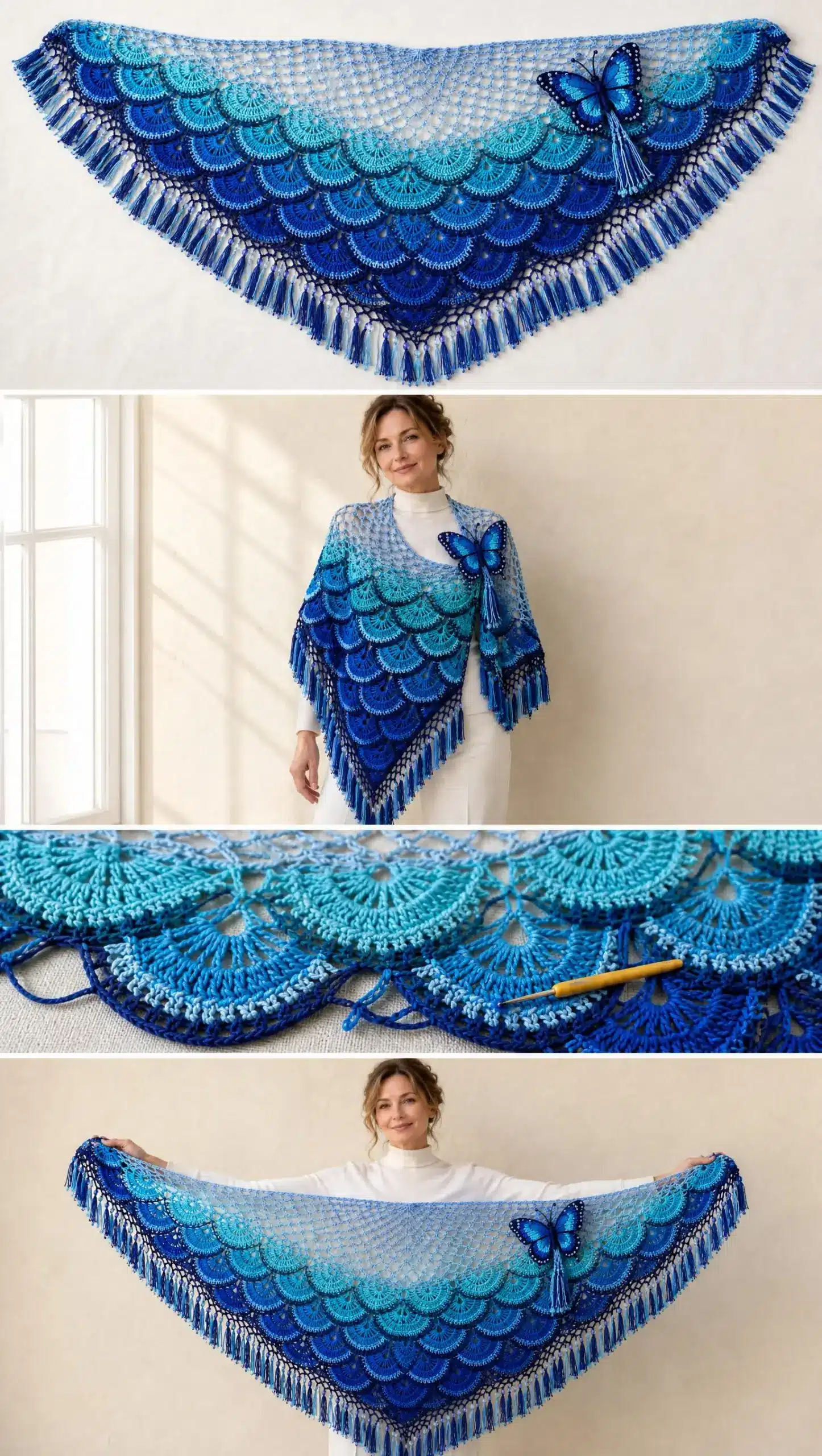
Getting gauge matters for this project since you are working to specific measurements.
- Mesh gauge: Approximately 7 chain 3 spaces by 8 rows equals 10 centimeters after blocking.
- Fan gauge: One finished large fan measures approximately 8.5 to 9 centimeters wide by 5.5 centimeters deep.
- Fringe: Approximately 20 to 24 centimeters finished length.
Important: The written counts create a generous adult shawl. If your row gauge differs, prioritize the finished depth measurement. Stop the mesh body when it reaches approximately 78 to 82 centimeters before the final border.
Abbreviations
Let me walk you through all the stitches and terms used in this pattern.
- ch = chain
- sl st = slip stitch
- sc = single crochet (insert hook, yarn over, pull through, yarn over, pull through both loops)
- hdc = half double crochet (yarn over, insert hook, yarn over, pull through, yarn over, pull through all three loops)
- dc = double crochet (yarn over, insert hook, yarn over, pull through, yarn over, pull through two loops, yarn over, pull through remaining two loops)
- tr = treble crochet (yarn over twice, insert hook, yarn over, pull through, then yarn over and pull through two loops three times)
- dtr = double treble crochet (yarn over three times, insert hook, yarn over, pull through, then yarn over and pull through two loops four times)
- sp = space
- sk = skip
- RS / WS = right side / wrong side
- picot = chain 3, slip stitch in first chain
- surface sl st = slip stitch embroidered on top of completed crochet
Special fan increase: When the pattern says “2 dc in same st,” work two double crochets into one stitch. “3 dc in same st” means three double crochets into one stitch. These increases build the radial spread of each fan.
Joining method: When a fan is joined to the shawl, replace the center chain of a joining loop with a slip stitch into the indicated body mesh space. This anchors the motif without flattening the raised outer edge.
Pattern Notes
- The construction method is top down triangular mesh with joined on scale motifs and a separate butterfly applique.
- The shawl begins at the center back neck and grows outward as an open triangular mesh.
- The upper section stays airy and pale blue, forming a delicate chain lace yoke across your shoulders.
- From the lower yoke downward, individual raised fan motifs get crocheted separately and then joined to selected mesh spaces in staggered rows.
- They overlap like the scales on a butterfly wing, creating that gorgeous dimensional texture you see in the photos.
- The final perimeter is stabilized with a navy mesh edging and finished with long mixed blue fringe.
- A sculptural four wing butterfly is worked separately and sewn at the upper right chest as the closure accent.
- Work over yarn tails wherever possible so finishing remains tidy.
- Texture tip: Steam block the fans very lightly or pin them dry. Do not flatten the outer ridge. The finished surface should retain a shallow cupped profile so adjacent rows cast small shadows.
- Check drape frequently. The scale field should remain flexible. If it starts to feel rigid, reduce the number of joining tacks between overlapping motifs.
- Optional top edge stabilization: If the shoulder line stretches excessively, work one row of navy or pale blue slip stitches along the upper edge. Keep this loose enough that the shawl still wraps naturally.
- For a functional closure, sew a small clear snap or flat hook and eye beneath the butterfly, attaching the matching half to the opposite front section. Do not rely on the decorative butterfly alone to bear strong pulling force.
- Weave all ends through at least 4 to 5 centimeters of same color stitches. Split yarn plies on the return pass for extra security.
Pattern Instructions
Part 1: Triangular Chain Lace Body
The body is a center out triangle. Every row adds one mesh space at each outer edge and two mesh spaces around the center point. Place a marker in the center chain 3 space and move it upward each row.
Foundation
Row 1 (RS): Chain 6. Double crochet in first chain made, chain 3, double crochet in same first chain, chain 3, double crochet again in same first chain. Turn.
You now have two triangular wings separated by a center chain 3 space.
Mesh Repeat
Row 2: Chain 6, double crochet in first double crochet (edge increase), chain 3, double crochet in next double crochet across to center chain 3 space; in center space work (double crochet, chain 3, double crochet); continue chain 3, double crochet in next double crochet across; chain 3, double crochet in same final double crochet (edge increase). Turn.
Rows 3 through 64: Repeat Row 2, always working one double crochet into each double crochet and chain 3 between posts. At the center chain 3 space work (double crochet, chain 3, double crochet). At each edge begin with chain 6 and finish with chain 3, double crochet in the final double crochet. This creates a stable triangular filet mesh.
Upper Shoulder Section
Work Rows 1 through 20 entirely in pale blue. At Row 20, the yoke should be approximately 23 to 27 centimeters deep after light stretching. If it is substantially smaller, continue pale blue until this depth is reached.
Lower Foundation Mesh
Rows 21 through 64 may remain pale blue or transition gradually through pale aqua. Most of this area will be covered by scales, so exact color changes are not critical. Keep the center point and both outer edges perfectly straight. Do not fasten off at the end of Row 64.
Body Size Check
Lay the triangle flat without stretching. Aim for approximately 78 to 82 centimeters from the center back start to the lower point, and 165 to 175 centimeters across the top edge. The border and blocking will add additional width and depth.
Part 2: Raised Fan Scale Motif
Make the scales individually and join them to the mesh. Each motif is semicircular with a raised navy outline. For a full size shawl, prepare approximately 58 to 72 large fans and 10 to 16 small fans. A useful starting mix is 22 turquoise or aqua, 18 medium cobalt, 24 deep cobalt, and 10 small side fans split among the same shades. Exact quantity depends on gauge and how densely you overlap them.
Large Fan (Main Motif)
Row A: With the scale color, chain 4 and join to form a ring. Chain 3 (counts as double crochet), work 8 double crochet into ring. Turn. 9 dc.
Row B: Chain 3, double crochet in same stitch; 2 double crochet in each of next 8 stitches. Turn. 18 dc.
Row C: Chain 4 (counts as treble crochet), treble crochet in same stitch, treble crochet in next stitch, 2 treble crochet in next stitch across. End with treble crochet in final stitch if needed to maintain shape.
Small Fan (For Narrowing Side Rows)
Work similarly to the large fan but with fewer stitches to create a narrower profile for the edges of the triangle.
Preparing Fan Colors
Change from turquoise to cobalt gradually over 5 to 7 scale rows. Reserve the darkest cobalt for the bottom third. Keep 5 to 8 millimeters of visible navy ridge between overlapping rows. If the overlap hides the ridge completely, move the next row slightly lower.
Part 3: Joining the Overlapping Scale Field
Row 1 of Scales
Place the shawl right side up. Count upward from the lower point. The first scale row begins approximately 27 to 30 centimeters below the top shoulder edge, leaving the pale blue mesh yoke exposed. Across a body mesh row, position large aqua fans side by side with their straight lower edges approximately level. Join each fan at three points: left upper corner, center top, and right upper corner. Anchor those points to three successive body mesh spaces. Leave 1 mesh space between adjacent fans if your motifs are wide; leave none if your gauge is narrow. The navy ridge faces outward and downward.
Row 2 and All Following Rows
Move the next fan row downward by approximately half a fan depth. Stagger every new fan so its center line falls over the gap between two fans above. Join each fan through the body mesh and, where they overlap, catch the hidden top edge of the lower fan to the back of the upper row with one discreet slip stitch or sewing tack. This creates the layered scale effect without producing a heavy solid sheet.
Shaping the Triangle
At both outer side edges, switch to small fans whenever a full fan would protrude beyond the triangle. At the center point, keep the lowest fan centered exactly on the vertical spine of the shawl. As the triangle narrows toward the bottom, reduce the number of motifs naturally rather than forcing equal counts in every row.
Part 4: Navy Mesh Border
Work Rows A and B only, then add the navy ridge around the curve. Finished width is approximately 6 to 6.5 centimeters.
Part 5: Long Beaded Fringe
Add a 16 to 20 centimeter mixed blue tassel at the lower body end. For the perimeter, use the translucent blue or clear beads threaded onto fringe strands.
Part 6: Blue Morpho Butterfly Closure
A sculptural four wing butterfly is worked separately and sewn at the upper right chest as the closure accent.
Upper Wing (Make 2)
With brilliant cyan, chain 7. Starting in 2nd chain from hook: single crochet, half double crochet, double crochet, treble crochet, double treble crochet, 5 double treble crochet in final chain.
Rotate to work along opposite side of foundation chain: double treble crochet, treble crochet, double crochet, half double crochet, single crochet. Join.
Round 2: With indigo, work single crochet around, placing 2 single crochet in each of the three outermost tip stitches to broaden the wing. Add 2 surface slip stitch vein lines from base toward tip.
Round 3: With navy, single crochet around outer edge. Every 4th or 5th stitch work picot. With icy blue, add tiny surface dots by making single loose French knot style yarn stitches or very short surface slip stitches between selected picots.
Lower Wing (Make 2)
With cyan, chain 6. Starting in 2nd chain: single crochet, half double crochet, double crochet, treble crochet, 4 double treble crochet in final chain; rotate and mirror back along the opposite side.
Work indigo and navy rounds as for the upper wings, but keep the shape shorter and rounder.
Body and Antennae
With navy, chain 15. Starting in second chain, slip stitch in 4 chains, single crochet in next 6 chains, half double crochet in next 3 chains, 3 half double crochet in final chain. Fasten off.
For each antenna, attach a 12 to 14 centimeter doubled strand of navy to the head end, twist lightly, knot the tip and trim.
Assembly
- Place the shawl right side up. Count upward from the lower point. The first scale row begins approximately 27 to 30 centimeters below the top shoulder edge, leaving the pale blue mesh yoke exposed.
- Across a body mesh row, position large aqua fans side by side with their straight lower edges approximately level. Join each fan at three points: left upper corner, center top, and right upper corner. Anchor those points to three successive body mesh spaces. Leave 1 mesh space between adjacent fans if your motifs are wide; leave none if your gauge is narrow. The navy ridge faces outward and downward.
- Arrange the upper wings above the lower wings with their narrow bases touching the body. Sew securely through several stitches at each wing base, leaving the outer two thirds of every wing free so it can lift slightly. Add a 16 to 20 centimeter mixed blue tassel at the lower body end.
- Position the butterfly at the upper right chest where the pale blue mesh meets the first scale row. Sew the body and inner wing bases to the shawl at 5 to 7 points. Leave wing tips free.
- For a functional closure, sew a small clear snap or flat hook and eye beneath the butterfly, attaching the matching half to the opposite front section. Do not rely on the decorative butterfly alone to bear strong pulling force.
- Weave all ends through at least 4 to 5 centimeters of same color stitches. Split yarn plies on the return pass for extra security.
Tips
- Yarn Choice Tip: Use a yarn with clear stitch definition and some drape. Mercerized cotton gives the crispest fan ribs and butterfly veins. Cotton bamboo blends give a softer fall. Avoid very fuzzy yarn because the layered scale structure depends on visible stitch architecture.
- Texture tip: Steam block the fans very lightly or pin them dry. Do not flatten the outer ridge. The finished surface should retain a shallow cupped profile so adjacent rows cast small shadows.
- Check drape frequently: The scale field should remain flexible. If it starts to feel rigid, reduce the number of joining tacks between overlapping motifs.
FAQs
Can I use a different weight of yarn?
The pattern is designed for fingering to sport weight smooth cotton or cotton bamboo blend. Using a significantly heavier yarn will alter the gauge and the size of the shawl, while a much lighter yarn may not provide the necessary structure for the scale motifs.
How do I adjust the size if my gauge is different?
The written counts create a generous adult shawl. If your row gauge differs, prioritize the finished depth measurement. Stop the mesh body when it reaches approximately 78 to 82 centimeters before the final border.
Do I need to block the shawl?
Yes, blocking is essential. Pin the upper edge straight and spread both wings evenly. Pin the lower point sharply, then smooth the side edges into a symmetrical triangle. Pin mesh sections open, but do not aggressively flatten the raised fan scales or butterfly wings.
How do I wear this shawl?
To reproduce the photographed drape, place the center back start slightly left of the spine when wrapping. Bring the left front section farther across the torso and allow its lower point to fall toward the lower center left. Bring the right side across more narrowly and secure beneath the butterfly. This creates the broad asymmetric V while keeping the butterfly unobstructed.
Is this pattern suitable for beginners?
No, this is an intermediate to advanced level crochet project. It requires patience, attention to color flow, and careful assembly of all those beautiful overlapping scales.
If you make this shawl, I would absolutely love to see it! Share your photos on Instagram or Facebook and tag me so I can admire your work. Save this Blue Morpho Butterfly Shawl crochet pattern to your Pinterest boards so you can find it whenever you are ready to start, and please drop a comment below if you have any questions or just want to share your progress. Happy crocheting!
Pin This Crochet Pattern!