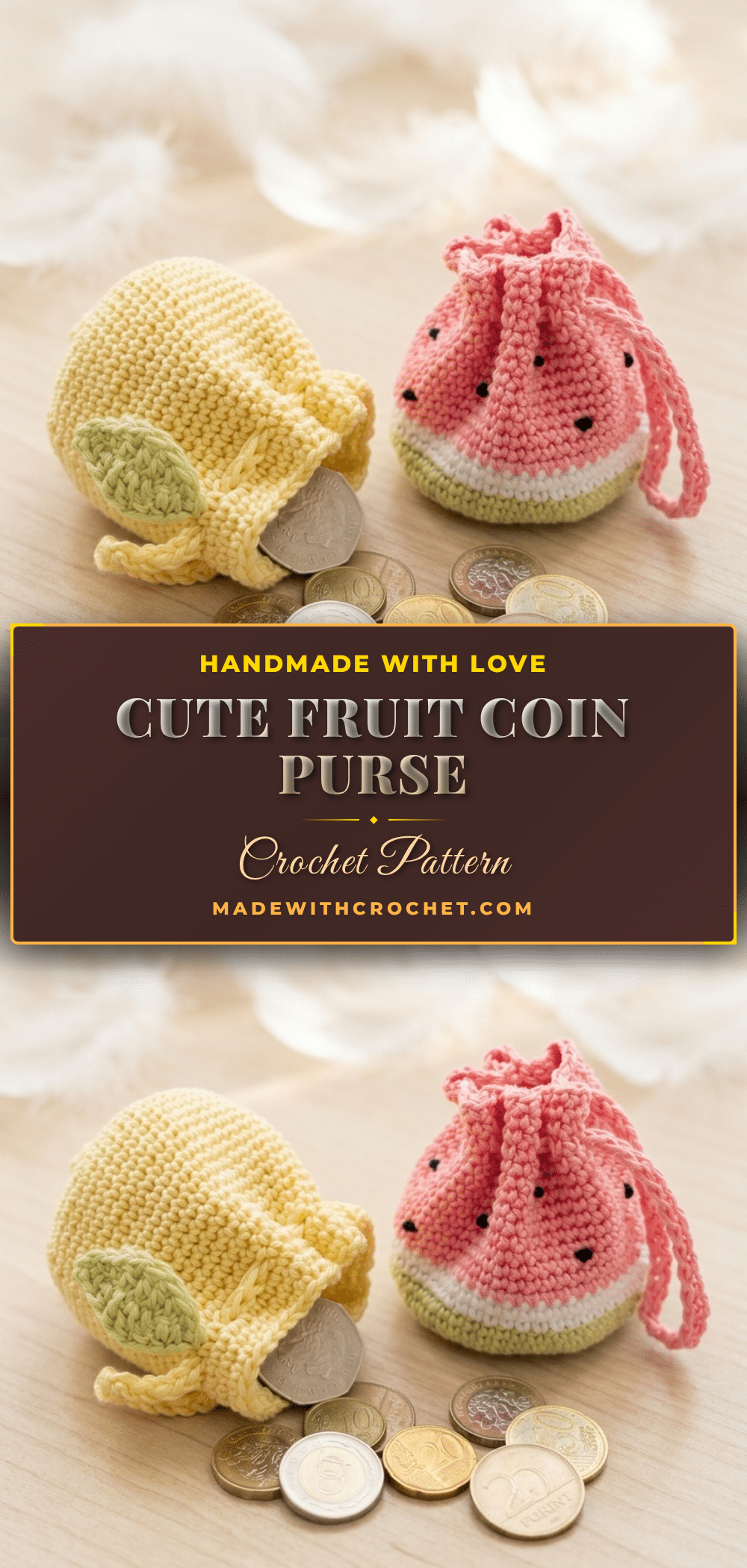
It is a common fear that starting a project with a magic circle will result in a hole so large you lose your keys through it. Or perhaps you worry that switching colors for a fruit design will create a messy, tangled mess on the inside. Rest assured, this cute crochet fruit coin purse pattern is designed to be forgiving. The sport weight yarn and tight 3.00 mm hook create a firm fabric that hides minor tension inconsistencies, and the color changes are managed simply by joining new yarn on the slip stitch. It is a project that feels approachable from the very first round.
Maker Notes
There is something deeply satisfying about making a project that is both functional and whimsical. This fruit coin purse is the perfect example of that balance. The sport weight yarn provides excellent stitch definition, allowing the green, white, and pink layers of the watermelon—or the bright yellow of the lemon—to pop without the fabric becoming too stiff or floppy. I love that this pattern allows for scrap-busting; the yardage requirements are low enough that you can dig into your stash for those small bits of color. Whether you are making a set for a child’s party favor or a quick gift for a friend who loves cute accessories, the small size means you can finish it in a single afternoon. The leaf detail adds a lovely finishing touch that elevates the design from a simple pouch to a charming piece of wearable art.
Project Overview
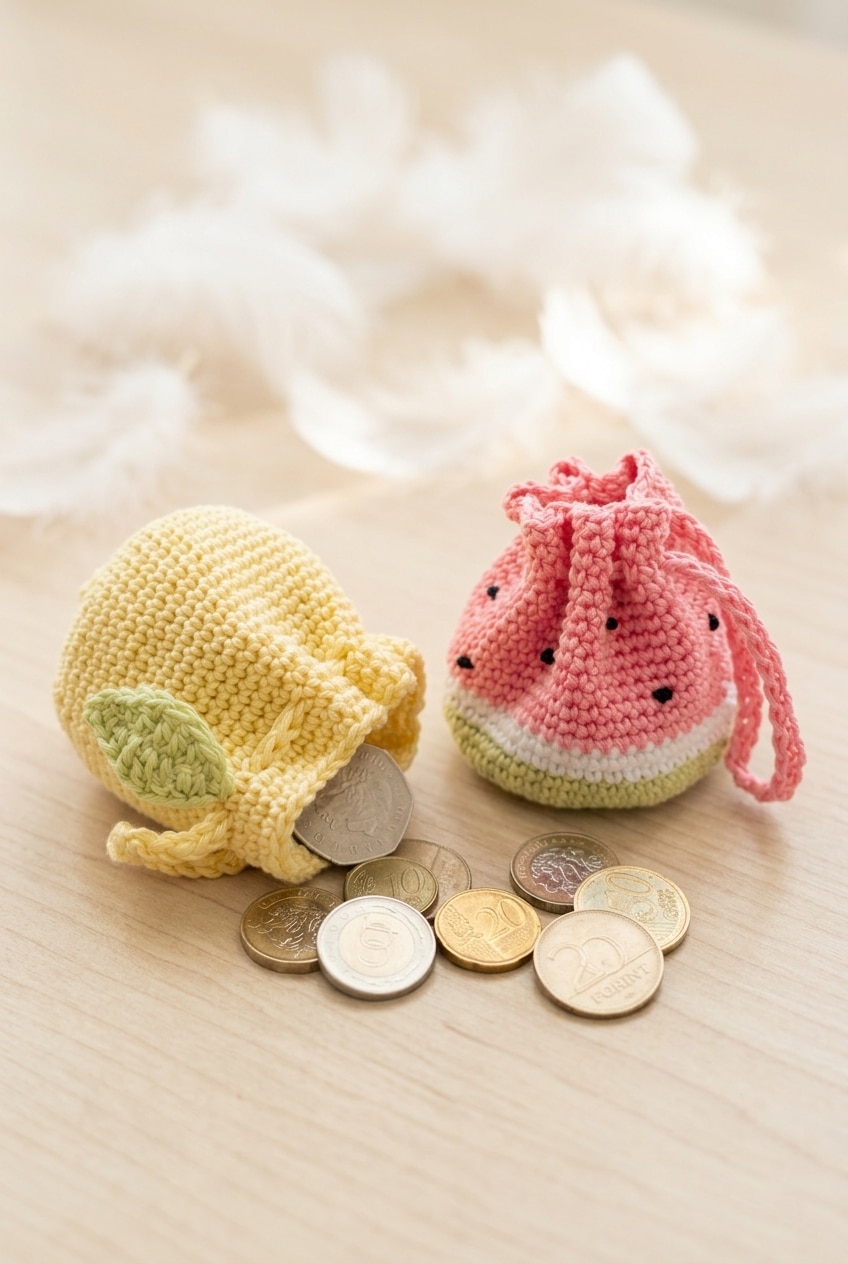
This pattern creates a small, round coin purse worked in continuous rounds from a magic circle. It features a drawstring closure created by eyelet spaces and includes a separate leaf appliqué. The design includes instructions for both a watermelon version and a lemon version, sharing most of the construction steps.
Materials
- Yarn: Sport Weight Yarn (Weight 2 Fine). You will need five colors total. For the watermelon, use green, white, pink, and black (for seeds). For the lemon, use yellow and black. While specific yardage is not listed, the small size means scraps work fine. You will likely need between 50 to 100 yards for the main colors (pink/yellow) and considerably less for accents. A cotton or cotton blend is recommended for structure, though smooth acrylic works well too.
- Hook: 3.00 mm crochet hook. This size pairs with sport weight to produce a firm, tight fabric essential for a bag that holds its shape.
- Notions: Yarn needle, scissors.
Gauge and Finished Size
Gauge: Gauge is not critical for this project. Use a hook size that creates a firm fabric suitable for a coin purse. If the fabric is too loose, the purse will be floppy; aim for a slightly tighter tension.
Finished Size: Approx. 4.5 in (11.5 cm) diameter coin purse.
Abbreviations
- ch = chain
- st(s) = stitch(es)
- sl st = slip stitch
- sc = single crochet
- hdc = half double crochet
- dc = double crochet
- mc = magic circle
- ch-sp = chain space
Note: This pattern uses US crochet terminology.
Pattern Notes
- Starting Stitches: Always start your first stitch in the same stitch as your previous slip stitch.
- Chain 1: The ch 1 at the end of each round does not count as a stitch. It is a turning chain to position your hook.
- Color Changes: Have all five colors wound and ready. Join new colors on the slip stitch that joins the previous round.
Pattern Instructions
Watermelon Purse
The watermelon purse is worked in the round from the center out. The color changes build the classic watermelon layers: green rind, white pith, and pink flesh.
Round 1: With green yarn, 7 sc in mc or ch 4 loop, sl st in first sc to join. [7 sc] Ch 1.
Round 2: 2 sc in each st around, sl st in first sc to join. [14 sc] Ch 1.
Round 3: *1 sc in next st, 2 sc in next st* repeat around, sl st in first sc to join. [21 sc] Ch 1.
Round 4: *1 sc in next 2 sts, 2 sc in next st* repeat around, sl st in first sc to join. [28 sc] Ch 1.
Round 5: *1 sc in next 3 sts, 2 sc in next st* repeat around, sl st in first sc to join. [35 sc] Ch 1.
Round 6: *1 sc in next 4 sts, 2 sc in next st* repeat around, sl st in first sc to join. [42 sc] Ch 1.
Round 7: *1 sc in next 5 sts, 2 sc in next st* repeat around, sl st in first sc to join. [49 sc] Ch 1. The shaping is done—the base is now 49 stitches and stays that way for the rest of the bag.
Rounds 8–10: 1 sc in each st around, sl st in first sc to join. [49 sc] Ch 1, join white yarn. Have your white yarn ready at the end of Round 10; the color change happens on the joining slip stitch.
Rounds 11–12: 1 sc in each st around, sl st in first sc to join. [49 sc] Ch 1, join pink yarn. Switch to pink on the slip stitch joining Round 12.
Rounds 13–22: 1 sc in each st around, sl st in first sc to join. [49 sc] Ch 1. Ten plain rounds in pink form the body of the purse.
Round 23: *1 sc in next 2 sts, ch 2, skip 2 sts* repeat around until last st, 1 sc in last st, sl st in first sc to join. [49 sc] Ch 1. These ch-2 spaces are the drawstring eyelets. Keep tension consistent here so the rope threads easily.
Round 24: *1 sc in next 2 sts, 2 sc in 2-ch sp* repeat around until last st, 1 sc in last st, sl st in first sc to join. [49 sc] Ch 1. Working into the chain spaces restores the stitch count.
Rounds 25–26: 1 sc in each st around, sl st in first sc to join. [49 sc] Ch 1. Fasten off on the last round and sew in all ends.
Lemon Purse
The lemon version follows nearly the same construction, with a different start to create a pointed tip.
Round 1: With yellow yarn, 7 sc in mc or ch 4 loop, sl st in first sc to join. [7 sc] Ch 1.
Round 2: 1 sc in each st around, sl st in first sc to join. [7 sc] Ch 1. Notice this round holds at 7 rather than doubling, giving the lemon its pointed tip shape.
Round 3: 2 sc in each st around, sl st in first sc to join. [14 sc] Ch 1.
Round 4: 1 sc in each st around, sl st in first sc to join. [14 sc] Ch 1.
Rounds 5–28: Repeat Rounds 3–26 of the Watermelon Purse. From here, the construction is identical to the watermelon. Follow those steps using yellow yarn throughout in place of the color sections.
Leaf
The leaf is a small flat piece worked along a foundation chain and back again.
Step 1: With green yarn, ch 10.
Step 2: Sl st in second ch from hook, 1 sc in next ch, 1 hdc in next ch, 1 dc in next 3 chs, 1 hdc in next ch, 1 sc in next ch, 3 sl st in last ch. The 3 slip stitches at the tip form the pointed end.
Step 3: Working back into chains again in the opposite direction, 1 sc in next ch along from sl sts, 1 hdc in next ch, 1 dc in next 3 chs, 1 hdc in next ch, 1 sc in next ch, sl st in last ch. You are mirroring the first side along the opposite edge.
Step 4: Fasten off and sew onto bag.
Rope Ties
There are two options for the drawstring rope, both threading through the eyelets on Round 23.
Option 1 (Quick Chain): Ch 37 sc foundation sts. Fasten off, weave through bag, and sew ends together.
Option 2 (Structured Rope): Ch 38. Sc in second ch from hook and in each ch along. [37 sc] This gives a sturdier rope with more body.
Assembly
Once all pieces are finished, sew the leaf onto the bag near the top. Weave the rope tie through the eyelet round. For Option 1, sew the ends of the rope together after threading to form a continuous loop. For Option 2, you can leave the ends loose to tie. Tack the leaf down with a few stitches through its base using the yarn tail.
Tips
- Tension Check: When working Round 23, keep your tension consistent. If it is too tight, the rope will not thread through the eyelets easily.
- Stitch Count: Remember that working into the chain spaces in Round 24 restores the stitch count back to 49.
- Care: Spot-cleaning is best for this purse. Submerging it in water can stress the woven-in ends and loosen the drawstring channel. If hand washing is necessary, use cool water, press out moisture with a towel (do not wring), and lay flat to dry.
FAQs
What is the drawstring channel in Round 23, and how does it work?
Round 23 creates eyelets by chaining 2 and skipping 2 stitches repeatedly around. These chain-2 spaces act as the channel through which the rope tie is threaded to close the purse.
What are the two rope tie options and is one easier than the other?
Option 1 is a simple chain of 37 stitches, which is quicker but less structured. Option 2 involves crocheting single crochet into the chain, creating a sturdier, more durable rope that holds its shape better.
Does the lemon purse use the same construction as the watermelon?
Yes. After the first four rounds (which create the pointed tip), the lemon purse follows the exact same increase and even rounds as the watermelon, simply using yellow yarn throughout.
Is the leaf sewn on or crocheted directly onto the bag?
The leaf is crocheted separately as a flat piece and then sewn onto the finished bag using the yarn tail.
What does ‘ch 1 does not count as a stitch’ mean for this pattern?
It means the chain 1 at the end of each round is only a turning chain to position your hook for the next round. You do not work into this chain; your first single crochet goes into the same stitch as the previous round’s slip stitch.
Pin This Crochet Pattern!