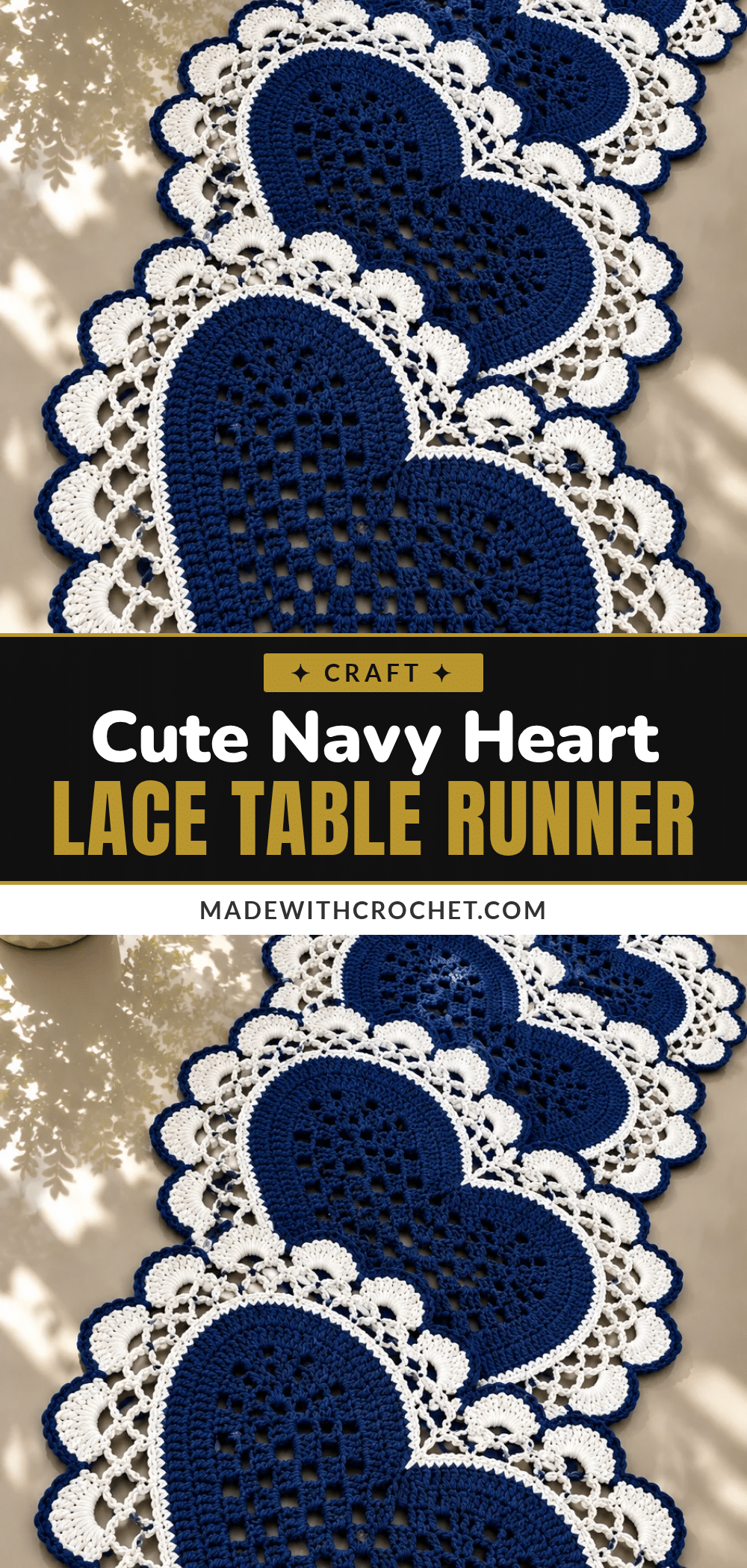
There is something undeniably charming about a finished piece that looks like it was pulled straight from a vintage heirloom collection. This Navy Heart Lace Table Runner is one of those projects that stops you in your tracks. It is display-worthy, elegant, and surprisingly approachable for crocheters who might find filet crochet intimidating at first glance. The combination of deep navy blue hearts framed by delicate white lace creates a striking contrast that feels both classic and timeless, making it a perfect centerpiece for dining tables, entryway consoles, or dresser tops.
Why the Finished Piece Stands Out
What makes this runner truly special is the balance between structure and airiness. The navy hearts are crafted using a filet technique that creates an open, lacy texture within the solid heart body, giving it visual interest without adding complexity. The white chain lace border and scalloped fans soften the bold navy centers, while the slight overlap of the four hearts creates a continuous, flowing design. It is a project that rewards patience; the repetitive nature of the heart motifs is meditative, and the final result is a sophisticated home decor item that feels handmade and personal. Whether you are using it for a wedding gift or a housewarming present, the quality of the mercerized cotton ensures it will last for years.
Project Overview
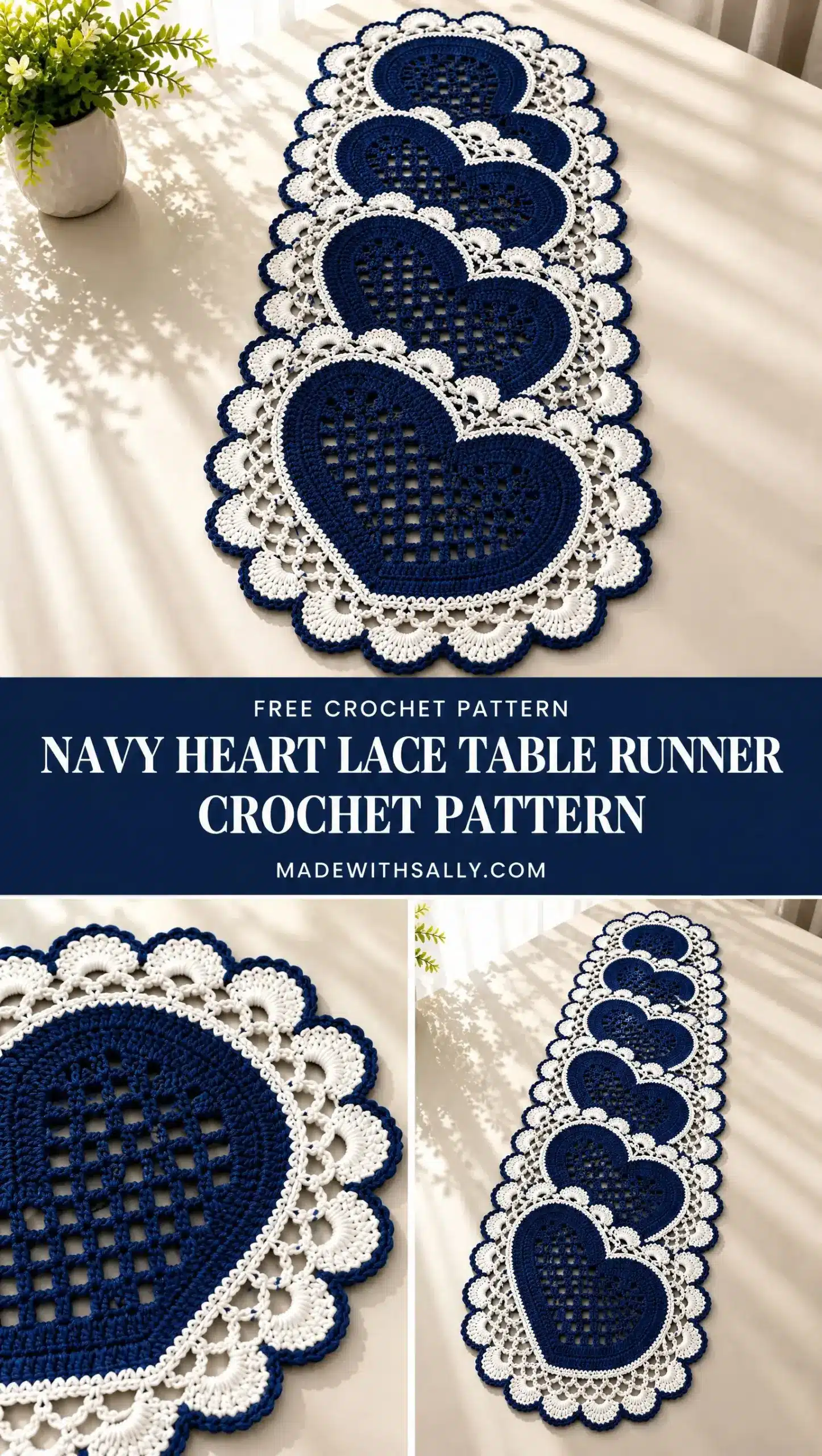
This crochet pattern creates a gorgeous table runner featuring four individually crocheted filet hearts in navy blue, each surrounded by white chain lace and scalloped fans, finished with a fine navy edge. The hearts overlap slightly to form a continuous runner. The design uses shaped rows to create clean, reproducible heart outlines. You will work from the bottom point of each heart upward toward the cleft, increasing steadily to form the classic heart silhouette. No complicated shaping worked all at once, and no confusing charts to decode—just one heart at a time, repeated four times.
Materials
- Yarn: Mercerized cotton sport weight yarn in navy blue (Color A): approximately 700 meters. Add 15% extra to be safe.
- Yarn: Mercerized cotton sport weight yarn in white (Color B): approximately 500 meters. Add 15% extra to be safe.
- Hook: 3 mm crochet hook, or size needed to match gauge.
- Notions: Tapestry needle for weaving ends, 8 stitch markers, and a ruler for measuring gauge.
Gauge and Finished Size
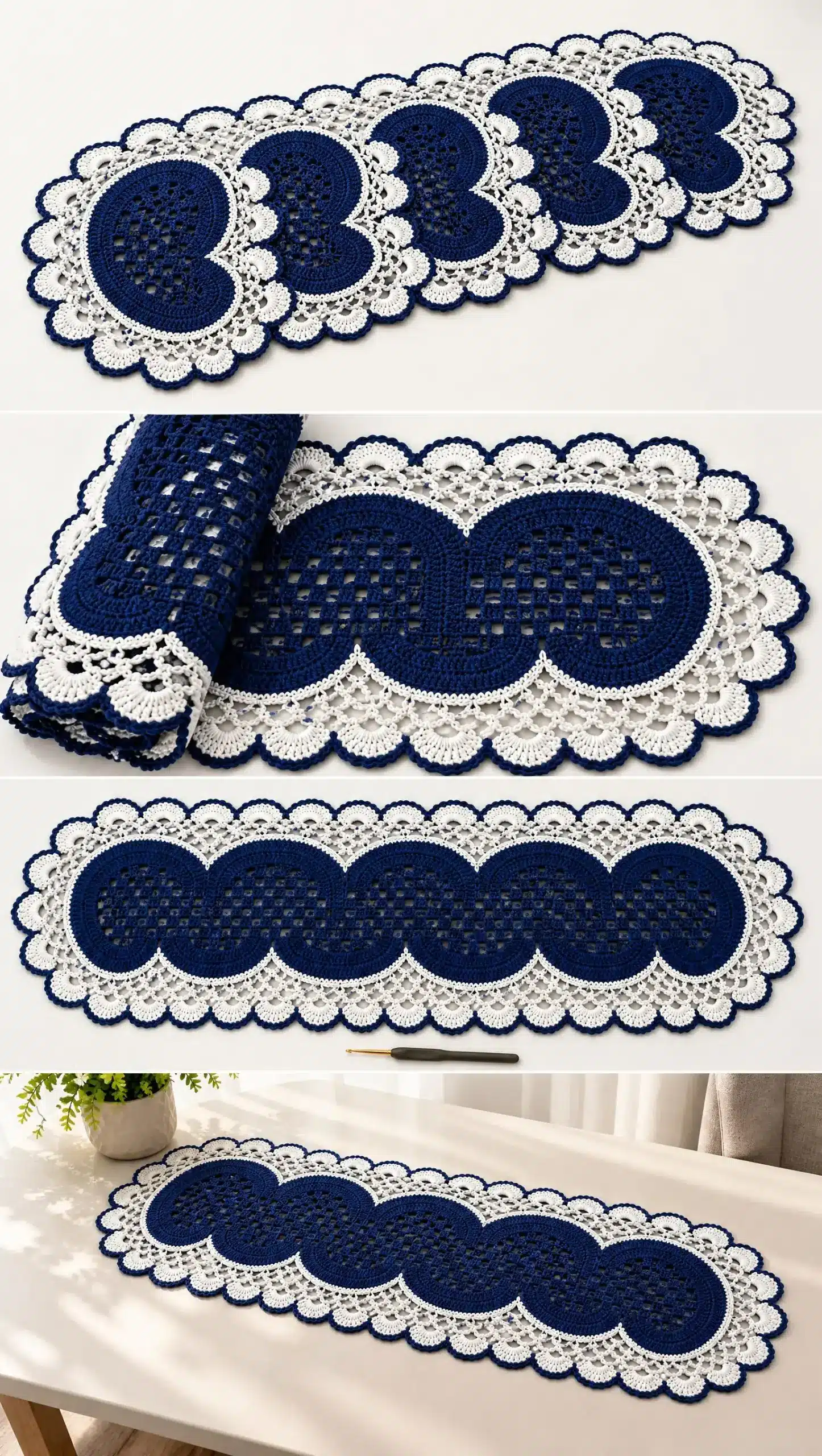
Gauge: 20 double crochet stitches by 11 rows equals 10 cm square, measured before adding the edging. The heart body reaches a maximum width of 49 double crochet positions, which works out to approximately 24.5 cm. Take time to check your gauge before committing to all four hearts. Consistent sizing across all motifs is essential for a professional finished look.
Finished Size: Each bordered heart measures approximately 30 to 35 cm wide and 31 to 34 cm tall. The completed runner measures about 110 to 120 cm long after accounting for the 3 to 5 cm overlaps between hearts.
Abbreviations
Before we begin, let me define every stitch and abbreviation you will encounter in this pattern:
- ch = chain: Wrap yarn over hook, pull through loop on hook. This creates the foundation and spacing throughout the pattern.
- sl st = slip stitch: Insert hook into stitch, yarn over, pull through both the stitch and the loop on your hook in one motion. Used for joining and moving across stitches without adding height.
- sc = single crochet: Insert hook into stitch, yarn over and pull up a loop (2 loops on hook), yarn over and pull through both loops. The shortest standard crochet stitch.
- hdc = half double crochet: Yarn over, insert hook into stitch, yarn over and pull up a loop (3 loops on hook), yarn over and pull through all 3 loops. Medium height stitch.
- dc = double crochet: Yarn over, insert hook into stitch, yarn over and pull up a loop (3 loops on hook), yarn over and pull through 2 loops, yarn over and pull through remaining 2 loops. The main stitch used for the heart body.
- st/sts = stitch or stitches
- sp = space: The gap created by chain stitches, where you will work into rather than into a solid stitch.
- RS/WS = right side or wrong side of your work
- rep = repeat
- Increase = Working 2 stitches into one stitch
- sc2tog or dc2tog = Single crochet two together or double crochet two together. This joins the next 2 stitches into 1, creating a decrease.
Important note: Turning chains do NOT count as a stitch unless a step explicitly says they do. This keeps your stitch counts accurate.
Pattern Notes
Whether you are an intermediate crocheter ready to try something new or a confident beginner looking for your next challenge, this pattern meets you where you are. I will walk you through every row, every stitch count, and every tricky spot so you can create a beautiful Navy Heart Lace Table Runner that looks like it belongs in a vintage heirloom collection. The construction breaks down into manageable pieces, making it an excellent follow-along project.
Pattern Instructions
Heart Body Instructions: Make Four
You will create four identical heart bodies using Color A (navy blue). Work from the lower point upward toward the cleft.
Row 1
Chain 4. Work 3 double crochet stitches in the fourth chain from hook. The unused chains serve as foundation only and do not count as a fourth stitch.
Stitch count: 3 dc. Turn.
Row 2
Chain 2 (does not count as a stitch). Work 2 dc in first stitch, dc in middle stitch, 2 dc in last stitch.
Stitch count: 5 stitches. Turn.
Rows 3 through 24: Shaping the Heart
Each row increases by 2 stitches. Work 2 dc in the first stitch, work across the middle according to the lace rule below, then work 2 dc in the last stitch.
Row n will have 2n+1 positions. Use these checkpoints to verify your counts:
- Row 6 = 13 positions
- Row 12 = 25 positions
- Row 18 = 37 positions
- Row 24 = 49 positions
The Lace Rule
On rows divisible by 3 (rows 3, 6, 9, 12, 15, 18, 21, and 24), you will create the filet lace pattern:
After the first increase, work (ch 1, skip next position, dc in next position) as many times as possible before reaching the last 2 old positions. Then ch 1, skip the penultimate position, and work 2 dc in the last position.
Example for Row 3: 2 dc in first st, ch 1, skip 1, dc in next, ch 1, skip 1, 2 dc in last st = 7 positions total.
All rows NOT divisible by 3 are solid double crochet rows. Simply increase at each end and dc across all middle stitches.
Rows 25 through 28: Even Rows
Work even over 49 positions without increasing.
- Rows 25, 26, and 28: Double crochet in every position. (49 stitches)
- Row 27: Dc in first stitch, then work (ch 1, skip 1, dc in next) 24 times. This creates 25 dc plus 24 ch-1 spaces.
Fasten off at the end of Row 28.
Shaping the Two Lobes
The top of each heart features two rounded lobes separated by a central cleft. You will work each lobe separately.
Marking the Split
With the right side facing you, count across Row 28. Mark position 25 for the central cleft. Leave this position unworked.
- Left lobe uses positions 1 through 24
- Right lobe uses positions 26 through 49
Work each lobe separately. Remember, ch 2 never counts as a stitch.
Lobe Row 1
Join Color A at the outside edge for the first lobe and work dc in 24 positions. For the second lobe, join at the cleft side and work 24 positions. This allows the same row instructions to mirror naturally.
Stitch count: 24 stitches. Turn.
Lobe Row 2
Ch 2, dc2tog over first 2 stitches, dc in next 20 stitches, dc2tog over last 2 stitches.
Stitch count: 22 stitches. Turn.
Lobe Row 3
Ch 2, dc2tog, dc in next 18 stitches, dc2tog.
Stitch count: 20 stitches. Turn.
Lobe Row 4
Ch 2, dc2tog, dc in next 16 stitches, dc2tog.
Stitch count: 18 stitches. Turn.
Lobe Row 5
Ch 2, dc2tog, dc in next 14 stitches, dc2tog.
Stitch count: 16 stitches. Turn.
Lobe Row 6
Ch 2, dc2tog, dc in next 12 stitches, dc2tog.
Stitch count: 14 stitches. Turn.
Lobe Row 7
Ch 2, dc2tog, dc in next 10 stitches, dc2tog.
Stitch count: 12 stitches. Fasten off.
Work the second lobe exactly the same way. You should now have a symmetric heart with a 7-row cleft and two softly sloping tops.
Smoothing the Body Edge
Join Color A at the lower point and single crochet evenly around the entire body edge:
- Work approximately 2 sc per dc row-end along the sides
- Work 1 sc per stitch across the top
- Work 3 sc at the bottom point
- At the deepest part of the cleft, work sc2tog to prevent a gap
If your edging begins to ruffle, reduce to 1 sc in selected row-ends. Mark the point and cleft positions. Join and fasten off.
This is an eased edging, not a fixed-count round. The goal is a smooth, flat edge that prepares the heart for the lace border.
Open Lace and Scallop Border
Once the heart body and edging are complete, you will add the delicate lace border using Color B (white). This involves outlining the heart, creating a mesh foundation, and finishing with scalloped fans. (Refer to the full PDF for the specific round-by-round instructions for Rounds 1-5 of the border).
Assembly
Arranging the Motifs
Arrange your four finished hearts in a line. The hearts overlap slightly to form a continuous runner. The completed runner measures about 110 to 120 cm long after accounting for the 3 to 5 cm overlaps between hearts.
Sewing the Joins
Using matching thread or split cotton yarn, make small whipstitches only where the two lace borders touch. Secure an area about 6 to 8 cm wide at each overlap.
Do not sew a hard straight seam through the centers. Keep joins flat with no dangling loops underneath. Lift the runner gently to confirm all sections remain securely connected.
Tips
- Count frequently. The stitch counts at the end of each row serve as checkpoints. If your numbers do not match, you will catch mistakes early when they are easy to fix.
- Block before joining. This cannot be overstated. Blocking evens out your tension and reveals any sizing discrepancies between hearts.
- Take your time with the lace border. The chain loops create the beautiful open lacework, but they can twist or tangle. Smooth out each round as you go.
- Use good lighting. Navy blue yarn can be difficult to see, especially when working into chain spaces. A bright lamp or daylight makes a significant difference.
FAQs
What type of yarn is best for this project?
The pattern calls for mercerized cotton sport weight yarn. This fiber provides the crisp definition needed for the filet crochet hearts and the durability required for a table runner. Using colorfast yarn is recommended to prevent the navy blue from bleeding into the white lace during washing.
How do I fix uneven hearts?
Consistent sizing is essential for a professional look. If your hearts vary significantly in size, consider remaking the outlier rather than forcing a match. Blocking each heart individually before assembly can also help even out tension and shape the lobes symmetrically.
Can I use a different hook size?
You can use a different hook size if needed to match the gauge, but the pattern is designed for a 3 mm hook. Changing the hook size will alter the gauge and the final dimensions of the hearts, potentially affecting how the lace border fits.
How do I care for the finished table runner?
Hand wash your finished table runner in cool water if your yarn label allows. Avoid wringing, which can distort the delicate lace. Lay flat to dry and reshape all scallops while damp. When using the runner on your table, place a protective layer beneath hot serving dishes to prevent heat damage to the cotton fibers.
Is this pattern suitable for beginners?
Whether you are an intermediate crocheter ready to try something new or a confident beginner looking for your next challenge, this pattern meets you where you are. The construction is broken down into manageable pieces, and the instructions are written to guide you through every step.
This Navy Heart Lace Table Runner makes a wonderful gift for weddings, anniversaries, or housewarmings. The classic navy and white color combination suits both traditional and modern décor. If you are looking for other easy DIY projects to add to your collection, you might also enjoy exploring cute lumiling amigurumi patterns or easy crochet fish amigurumi for smaller gifts.
Pin This Crochet Pattern!