There is something undeniably cheerful about pulling a skein of mustard or ocher cotton from a stash bin and knowing it is destined for a project that brings warmth to the shoulders. For this headscarf, the color story feels like a deliberate choice to capture the essence of a late-summer meadow. The interplay of cream, sage, and chocolate brown isn’t just about contrast; it is about creating a piece that feels intentional, grounded in nature, and ready to be worn as a statement of boho elegance. This pattern allows you to curate that exact feeling, transforming simple cotton strands into a wearable work of art.
Yarn and Color Notes
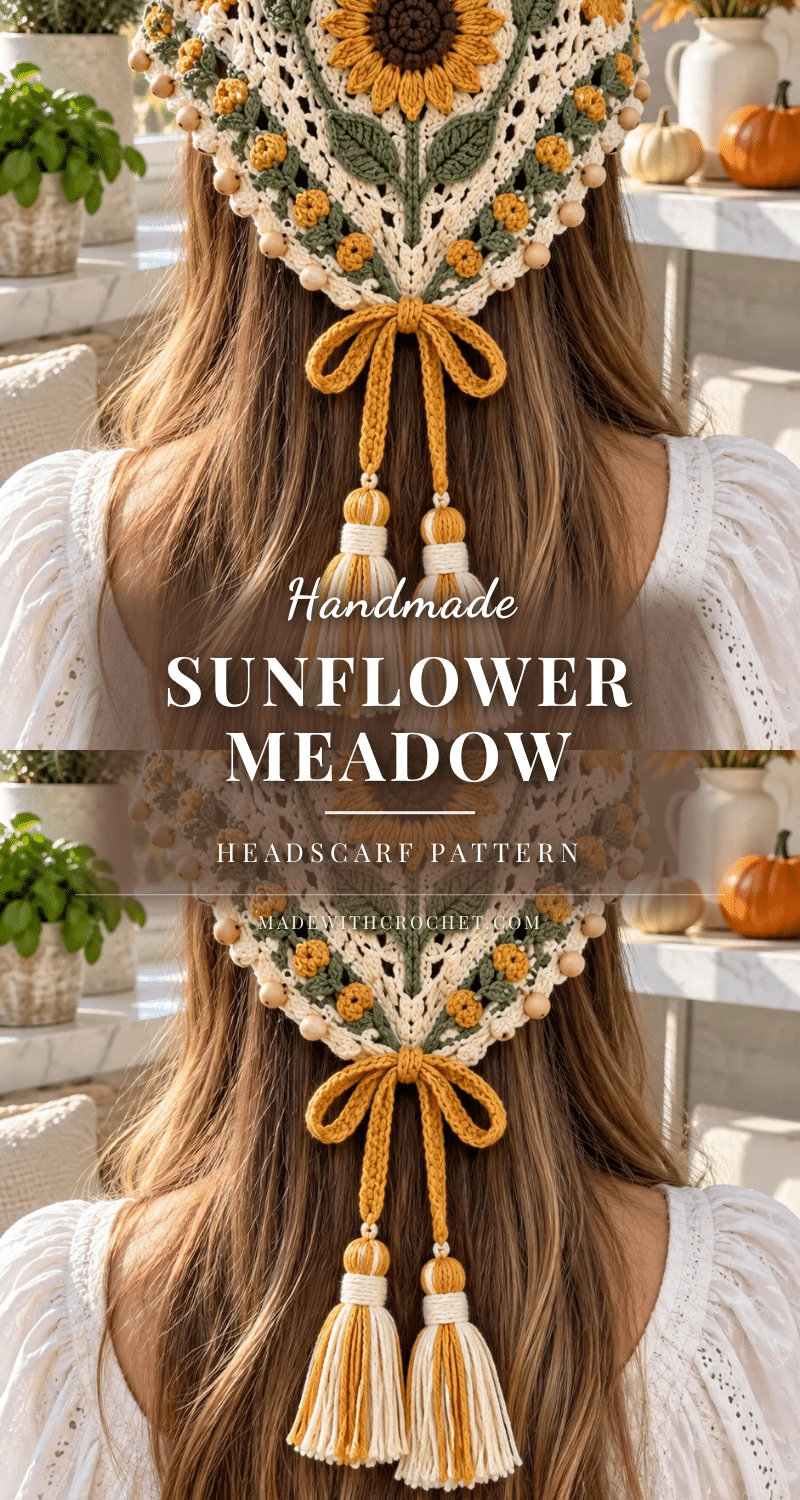
The beauty of the Sunflower Meadow Headscarf lies in its texture and the way the colors interact. The cream yarn serves as the canvas, taking up the most yardage to create a clean, airy lattice. However, the soul of the piece comes from the accent colors. The mustard and gold petals pop against the cream, while the chocolate brown centers provide a rich, dimensional anchor. The sage green leaves add a touch of organic realism, lifting slightly off the fabric to create depth. This is an excellent project for using up partial skeins; the smaller amounts of ocher and brown are perfect for finishing touches, while the wooden beads catch the light to add a natural, tactile element to the finished piece.
Project Overview
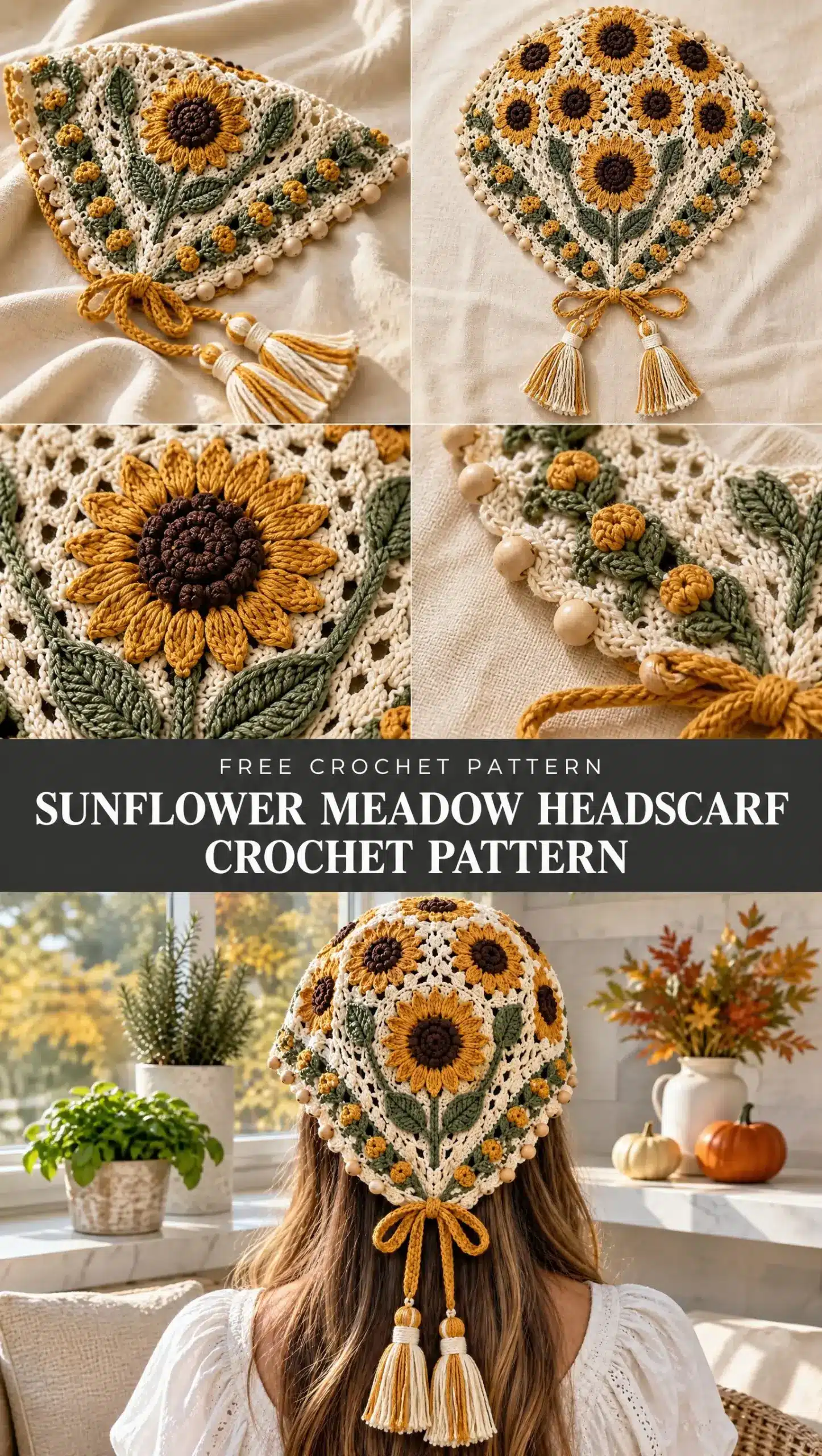
This triangular headscarf combines openwork lace, dimensional sunflower motifs, a leafy edging, wooden beads, and cream-and-gold tassels. The construction uses basic stitches with a few special techniques like bobbles and join-as-you-go. You will need fingering weight cotton, a 3.25 mm hook, and about 450 to 520 yards total. The pattern builds in three main sections. First you crochet sunflower motifs and join them into a crown panel. Then you work a lacy triangle downward to a point. Finally you add the decorative border, stems, leaves, buds, beads, tie cords, and tassels. If you can work double crochet, treble crochet, and simple decreases, you can make this headscarf. The skill level is confident beginner to intermediate. Take your time with the motifs and the rest flows smoothly.
The Sunflower Meadow Headscarf looks intricate but breaks down into manageable pieces. Each small sunflower takes about 20 minutes once you get the rhythm. The openwork triangle uses a simple chain lattice that decreases on each side until you reach the point. No complicated shaping math required. The finished scarf has real presence. Those raised brown bobble centers give the flowers depth without bulk. The sage leaves lift slightly off the fabric. The wooden beads catch the light. When you tie the mustard bow at the back and let those tassels hang, you have something genuinely beautiful. This is a great project for using up partial skeins of cotton in coordinating colors. The cream takes the most yardage, but the accent colors need smaller amounts. Check your stash for mustard, sage green, chocolate brown, and ocher.
Materials
- Yarn: Fingering or light sport weight cotton, approximately 450 to 520 yards total. Here is the suggested color breakdown:
- Cream: 260 to 300 yards
- Mustard/gold: 110 to 130 yards
- Sage green: 55 to 70 yards
- Chocolate brown: 25 to 35 yards
- Ocher: 15 to 20 yards
- Hook: 3.25 mm crochet hook, or the size needed to obtain gauge.
- Notions:
- 12 to 18 light unfinished wooden beads, 10 to 12 mm, with holes large enough for a doubled strand
- Tapestry needle
- Locking stitch markers
- Sharp scissors
- Rustproof pins
- Measuring tape
- Blocking mat and spray bottle or basin for wet blocking
- Optional: 1.75 to 2.25 mm steel hook or dental floss threader to pull yarn through beads.
Gauge and Finished Size
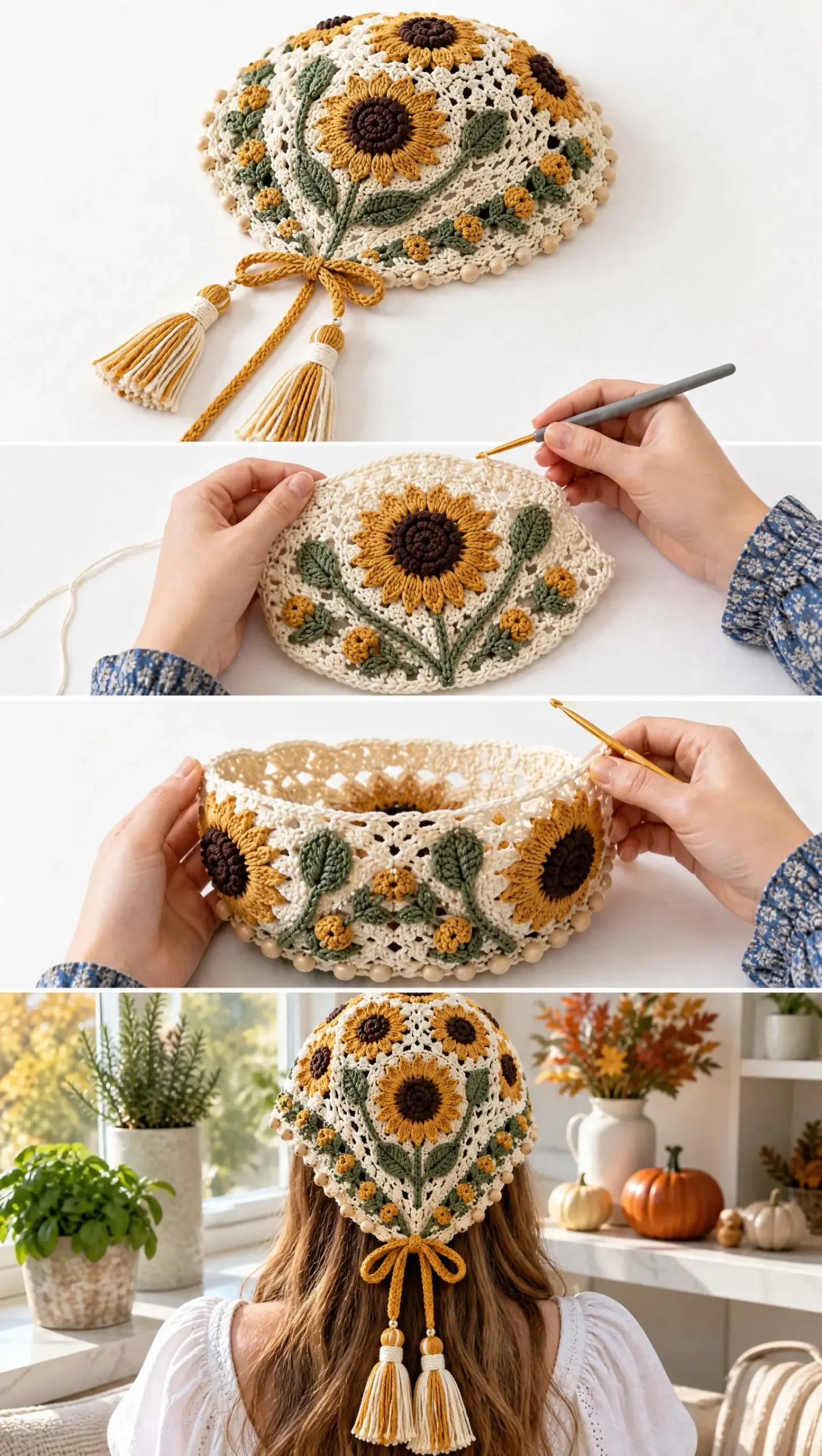
After blocking, one small sunflower motif measures about 3.25 inches across. Six openwork mesh spaces measure about 4 inches. Seven rows of the lower lattice measure about 3 inches. Exact gauge matters less than achieving a supple fabric and hitting the target finished width of 26 inches across the top edge.
Finished Measurements
- Top edge width: 26 in / 66 cm (Adjustment Range: 24 to 28 in)
- Depth to point: 17 in / 43 cm (Adjustment Range: 15 to 19 in)
- Tie cord, each end: 18 in / 46 cm (Adjustment Range: 14 to 22 in)
- Tassel length: 5.5 in / 14 cm (Adjustment Range: 4 to 6 in)
Sizing and Customization Tips
- For a smaller scarf: Use 6 small motifs and 45 lower-edge anchors. Stop the triangle 2 to 3 rows earlier. Aim for 23 to 24 inches top width.
- For a larger scarf: Use all 7 small motifs in the crown and 53 to 55 anchors. Add 2 to 4 even lattice rows. Aim for 27 to 29 inches top width.
- For more drape: Use a 3.5 mm hook or slightly finer yarn.
- For more structure: Use a 3.0 mm hook and mercerized cotton.
Abbreviations
Before we dive into the pattern, let me define every stitch and abbreviation you will encounter.
- ch = chain: Yarn over, pull through the loop on your hook.
- sl st = slip stitch: Insert hook, yarn over, pull through both the stitch and the loop on your hook in one motion.
- sc = single crochet: Insert hook, yarn over, pull up a loop (two loops on hook), yarn over, pull through both loops.
- hdc = half double crochet: Yarn over, insert hook, pull up a loop (three loops on hook), yarn over, pull through all three loops.
- dc = double crochet: Yarn over, insert hook, pull up a loop, yarn over, pull through two loops, yarn over, pull through remaining two loops.
- tr = treble crochet: Yarn over twice, insert hook, pull up a loop, (yarn over, pull through two loops) three times.
- dtr = double treble crochet: Yarn over three times, insert hook, pull up a loop, (yarn over, pull through two loops) four times.
- yo = yarn over
- sp = space
- sk = skip
- st(s) = stitch(es)
- RS / WS = right side / wrong side
- MR = magic ring
- beg = beginning
- rep = repeat
- picot = ch 3, sl st in first ch
Pattern Notes
This triangular headscarf combines openwork lace, dimensional sunflower motifs, a leafy edging, wooden beads, and cream-and-gold tassels. The construction uses basic stitches with a few special techniques like bobbles and join-as-you-go. You will need fingering weight cotton, a 3.25 mm hook, and about 450 to 520 yards total.
The pattern builds in three main sections. First you crochet sunflower motifs and join them into a crown panel. Then you work a lacy triangle downward to a point. Finally you add the decorative border, stems, leaves, buds, beads, tie cords, and tassels. If you can work double crochet, treble crochet, and simple decreases, you can make this headscarf.
Take your time with the motifs and the rest flows smoothly.
The Sunflower Meadow Headscarf looks intricate but breaks down into manageable pieces. Each small sunflower takes about 20 minutes once you get the rhythm. The openwork triangle uses a simple chain lattice that decreases on each side until you reach the point. No complicated shaping math required. The finished scarf has real presence. Those raised brown bobble centers give the flowers depth without bulk. The sage leaves lift slightly off the fabric. The wooden beads catch the light. When you tie the mustard bow at the back and let those tassels hang, you have something genuinely beautiful. This is a great project for using up partial skeins of cotton in coordinating colors. The cream takes the most yardage, but the accent colors need smaller amounts. Check your stash for mustard, sage green, chocolate brown, and ocher.
Special Stitches
These special stitches create the dimensional details that make this headscarf stand out.
Brown Bobble Center (5-dc bobble)
Yarn over, insert hook in the same stitch, pull up a loop, yarn over and pull through 2 loops. Repeat this 5 times total in the same stitch. You will have 6 loops on your hook. Yarn over and pull through all 6 loops. Chain 1 to close. This creates that bumpy, textured center of each sunflower.
Elongated Petal
Work all of this into one indicated stitch or space: slip stitch, ch 2, 2 tr, 1 dtr, 2 tr, ch 2, slip stitch. The dtr at the center makes the petal point taller than a standard petal.
Raised Narrow Leaf
Chain 7. Working back along the chain: sl st in 2nd ch from hook, sc, hdc, dc, hdc, sc, sl st into stem. For a plumper leaf, work the same sequence on the opposite side of the foundation chain before fastening to the stem.
Bud
Into a ch-2 loop: (yarn over, insert hook, pull up a loop, yarn over, pull through 2) three times, yarn over and pull through all 4 loops. Chain 1.
Shell Edging
5 dc in the indicated space or stitch.
Join-As-You-Go (JAYG)
On the final petal or chain loop of a motif, replace the center chain with a slip stitch into the matching point on the neighboring motif, then complete the petal or loop.
Pattern Instructions
Construction Overview
You will build this headscarf in a specific order:
- Crochet 7 small sunflower motifs and 1 larger focal sunflower
- Join 6 small motifs into a shallow crown arc (3 on the upper row, 3 staggered below)
- Add a cream joining round around the motif group
- Crochet the lower openwork triangle downward, decreasing until one point remains
- Attach the larger focal sunflower at center back with sage stems and raised leaves
- Work decorative ocher buds and sage leaves along both V-shaped sides
- Work one sage stripe, then the final cream shell border with wooden beads
- Crochet the mustard point cord and bow, then make and attach two tassels
- Wet block gently
Small Sunflower Motif (Make 7)
Finished blocked diameter: approximately 3.25 inches. Work the center in chocolate brown, petals in mustard, and the joining round in cream.
Round 1 (brown): MR, ch 1, work 12 sc in ring. Join with sl st to first sc. (12 sc)
Round 2 (brown bobbles): Ch 1. In each sc around, work 1 bobble, ch 1. Join with sl st to top of first bobble. (12 bobbles, 12 ch-1 sps)
Round 3 (mustard petal bases): Join mustard in any ch-1 sp. Ch 1, sc in ch-1 sp, ch 3; repeat from around. Join. (12 ch-3 sps)
Round 4 (elongated petals): In each ch-3 sp work: sl st, ch 2, 2 tr, 1 dtr, 2 tr, ch 2, sl st. Fasten off. (12 petals)
Round 5 (cream stabilizing lattice): With RS facing, join cream in the valley between any 2 petals. Ch 4, sc in next valley; repeat from around. Join. Do not pull tightly. (12 ch-4 sps)
Round 6 (cream joining round): Sc in next ch-4 sp, ch 3, sc in same sp, ch 2; repeat from around. Join. Use these ch-3 points for JAYG. Fasten off unless joining immediately.
Large Center-Back Sunflower (Make 1)
Finished diameter: approximately 4.5 to 5 inches. This focal flower gets sewn on after the scarf body is complete.
Round 1 (brown): MR, ch 1, 12 sc. Join. (12)
Round 2 (brown): Ch 1, 2 sc in each st around. Join. (24)
Round 3 (bobble texture): *Bobble in next st, ch 1, sk next st; repeat around. Join. (12 bobbles)
Round 4 (mustard bases): Join mustard in any ch-1 sp. *Sc in sp, ch 4; repeat around. Join. (12 ch-4 sps)
Round 5 (petals): In each ch-4 sp work: sl st, ch 2, 2 tr, 2 dtr, 2 tr, ch 2, sl st. (12 petals)
Round 6 (outer petal layer): Working behind Round 5, join mustard around the post/valley between petals. *Ch 5, sl st around next valley; repeat around. In each ch-5 sp work: sc, hdc, 2 dc, tr, 2 dc, hdc, sc. Fasten off.
Join the Floral Crown Panel
Block the small motifs lightly before joining so their diameters are consistent. Arrange them with petals touching but not compressed.
- Place three motifs in a top row. Join neighboring motifs at two adjacent cream ch-3 points using JAYG or whipstitch through the outer cream loops.
- Place three motifs below, staggered so each lower motif sits beneath a gap between upper motifs. Join at 2 to 3 matching ch-3 points wherever motifs meet.
- If the crown measures less than about 22 inches across before edging, place the 7th small motif near one outer side or centered between two lower motifs.
- With cream, work a smoothing round around the entire joined panel: sc in each accessible ch-space and valley, ch 2 across small gaps, ch 3 across deeper gaps. The goal is a continuous edge, not a precise stitch count.
- Along the lower edge only, mark 49 evenly spaced anchor points. These anchors form the foundation for the openwork triangle.
Weave in every end on the WS, changing direction at least once so cotton ends do not slip out.
Lower Openwork Triangle
(Note: Specific row-by-row instructions for the triangle decrease are not provided in the source excerpt, but the construction relies on the 49 anchor points marked in the previous step to create the lattice that decreases on each side until one point remains.)
Center Flower, Stems and Raised Leaves
Attach the larger focal sunflower at center back with sage stems and raised leaves using the special stitches defined above.
Ocher Buds and Sage Leaves on the V-Sides
Work decorative ocher buds and sage leaves along both V-shaped sides of the triangle.
Sage Stripe, Cream Shell Border and Beads
Work one sage stripe, then the final cream shell border with wooden beads.
Mustard Tie Bow and Two Tassels
Crochet the mustard point cord and bow, then make and attach two tassels.
Point Cord
Create the cord to tie the scarf at the back.
Tassels (Make 2)
Create two tassels to hang from the ends of the tie cord.
Assembly
On the final petal or chain loop of a motif, replace the center chain with a slip stitch into the matching point on the neighboring motif, then complete the petal or loop.
Block the small motifs lightly before joining so their diameters are consistent. Arrange them with petals touching but not compressed.
- Place three motifs in a top row. Join neighboring motifs at two adjacent cream ch-3 points using JAYG or whipstitch through the outer cream loops.
- Place three motifs below, staggered so each lower motif sits beneath a gap between upper motifs. Join at 2 to 3 matching ch-3 points wherever motifs meet.
- If the crown measures less than about 22 inches across before edging, place the 7th small motif near one outer side or centered between two lower motifs.
- With cream, work a smoothing round around the entire joined panel: sc in each accessible ch-space and valley, ch 2 across small gaps, ch 3 across deeper gaps. The goal is a continuous edge, not a precise stitch count.
- Along the lower edge only, mark 49 evenly spaced anchor points. These anchors form the foundation for the openwork triangle.
Weave in every end on the WS, changing direction at least once so cotton ends do not slip out.
Wet block in cool to lukewarm water with a small amount of wool wash or mild soap. Gently squeeze but do not wring.
Pin the top edge straight to the target width. Shape the lower sides into a clean V and pin the point centrally. Shape each sunflower petal individually. Lift the brown centers slightly so they remain dimensional. Arrange the sage leaves with a gentle upward curve.
Allow to dry completely before removing pins.
Tips
- Take your time with the motifs and the rest flows smoothly.
- The Sunflower Meadow Headscarf looks intricate but breaks down into manageable pieces. Each small sunflower takes about 20 minutes once you get the rhythm. The openwork triangle uses a simple chain lattice that decreases on each side until you reach the point. No complicated shaping math required. The finished scarf has real presence. Those raised brown bobble centers give the flowers depth without bulk. The sage leaves lift slightly off the fabric. The wooden beads catch the light. When you tie the mustard bow at the back and let those tassels hang, you have something genuinely beautiful. This is a great project for using up partial skeins of cotton in coordinating colors. The cream takes the most yardage, but the accent colors need smaller amounts. Check your stash for mustard, sage green, chocolate brown, and ocher.
- Exact gauge matters less than achieving a supple fabric and hitting the target finished width of 26 inches across the top edge.
- Sizing and Customization Tips For a smaller scarf: Use 6 small motifs and 45 lower-edge anchors. Stop the triangle 2 to 3 rows earlier. Aim for 23 to 24 inches top width. For a larger scarf: Use all 7 small motifs in the crown and 53 to 55 anchors. Add 2 to 4 even lattice rows. Aim for 27 to 29 inches top width. For more drape: Use a 3.5 mm hook or slightly finer yarn. For more structure: Use a 3.0 mm hook and mercerized cotton.
Troubleshooting Common Issues
- Triangle curls inward: Your side decreases may be too aggressive or your chains are too tight. Add an even row or increase ch-4 spaces to ch-5 for one or two rows.
- Triangle flares or ruffles: Your edge chains are too loose or too many stitches were added in the border. Reduce the number of side sc stitches and re-block.
- Flowers look bulky: Use a finer yarn for the brown centers or replace 5-dc bobbles with 4-dc bobbles.
- Petals flatten after blocking: Re-wet only the petals, pinch each tip, and dry with the centers slightly lifted.
Care Instructions
Hand wash in cool water with mild detergent. Roll in a towel to remove excess water, reshape flat, and air dry. Do not machine dry. If using unfinished wooden beads, avoid prolonged soaking and dry them promptly. Store flat or loosely folded so the raised petals and tassels are not crushed.
FAQs
What type of yarn is best for this headscarf?
Fingering or light sport weight cotton is recommended to achieve the correct drape and structure. The pattern suggests using cream, mustard, sage green, chocolate brown, and ocher.
Can I make this headscarf smaller?
Yes. To make a smaller scarf, use 6 small motifs and 45 lower-edge anchors. Stop the triangle 2 to 3 rows earlier to aim for a 23 to 24 inch top width.
How do I join the sunflower motifs?
You can use the Join-As-You-Go (JAYG) method by replacing the center chain of the final petal with a slip stitch into the neighboring motif, or you can whipstitch through the outer cream loops after blocking the motifs.
What if my triangle curls inward?
If the triangle curls, your side decreases may be too aggressive or your chains are too tight. Try adding an even row or increasing ch-4 spaces to ch-5 for one or two rows.
How should I care for the wooden beads?
If using unfinished wooden beads, avoid prolonged soaking during washing. Dry them promptly after hand washing to prevent damage.
The Sunflower Meadow Headscarf looks intricate but breaks down into manageable pieces. Each small sunflower takes about 20 minutes once you get the rhythm. The openwork triangle uses a simple chain lattice that decreases on each side until you reach the point. No complicated shaping math required. The finished scarf has real presence. Those raised brown bobble centers give the flowers depth without bulk. The sage leaves lift slightly off the fabric. The wooden beads catch the light. When you tie the mustard bow at the back and let those tassels hang, you have something genuinely beautiful. This is a great project for using up partial skeins of cotton in coordinating colors. The cream takes the most yardage, but the accent colors need smaller amounts. Check your stash for mustard, sage green, chocolate brown, and ocher.
The finished piece works beautifully for late summer and early fall. Wear it to a farmers market, an outdoor wedding, or just running errands when you want to feel put together. It also makes a memorable gift for anyone who loves sunflowers or boho accessories. If you make this sunflower headscarf, I would love to see your finished piece. Tag me on Instagram or share a photo in our Facebook group. And if you want to come back to this pattern later, go ahead and save it to your Pinterest boards so it is easy to find when you are ready to start. Drop a comment below if you have any questions or just want to share your progress. Happy crocheting!
Pin This Crochet Pattern!