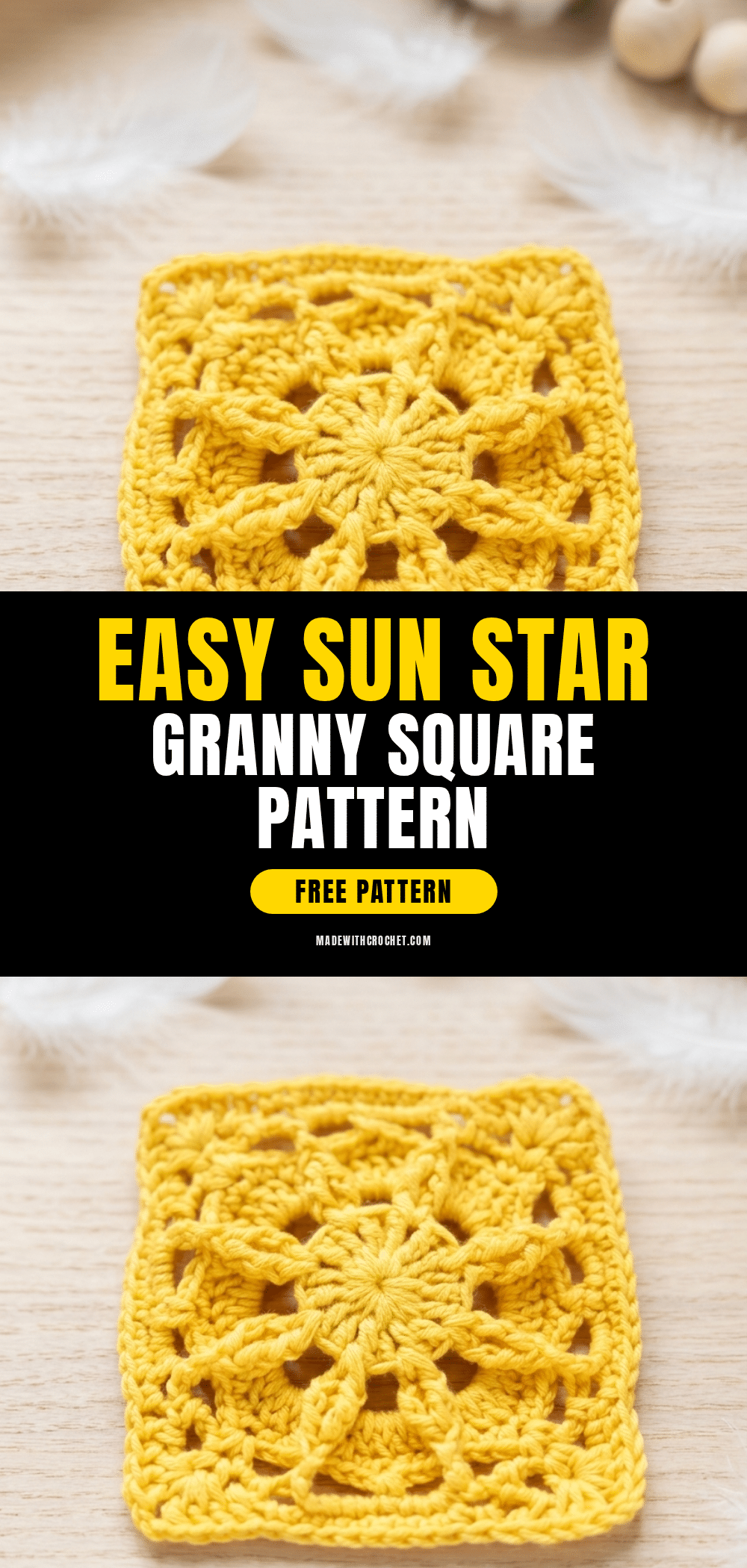
There is something deeply satisfying about watching a motif build itself from the center out, round by round, as the texture grows more complex and the shape begins to emerge. This Sun Star Granny Square is a perfect example of that architectural joy. It moves beyond the standard granny square by incorporating front post stitches and clusters that create a raised, dimensional surface. The way the stitches radiate from the center before settling into a clean border makes the process feel engaging rather than repetitive. You will find yourself curious to see how each round develops, especially as the starburst construction takes hold.
Texture and Stitch Notes
The real appeal of this pattern lies in the tactile experience of the stitches. The dccl (double crochet cluster) stitches are not just decorative; they are load-bearing, providing the structure for the star points and corners. Working around the posts of previous rounds with the dcfps and tr2tog requires a consistent tension to keep the fabric neat, but the result is a sturdy, beautiful motif that stands up on its own. This texture makes it an excellent choice for home decor items like coasters or pillow panels, where the fabric needs to hold its shape. It is also a versatile building block that pairs well with other motifs, such as the Sunflower Granny Square Cardigan, if you are looking to create a larger, themed garment.
Project Overview
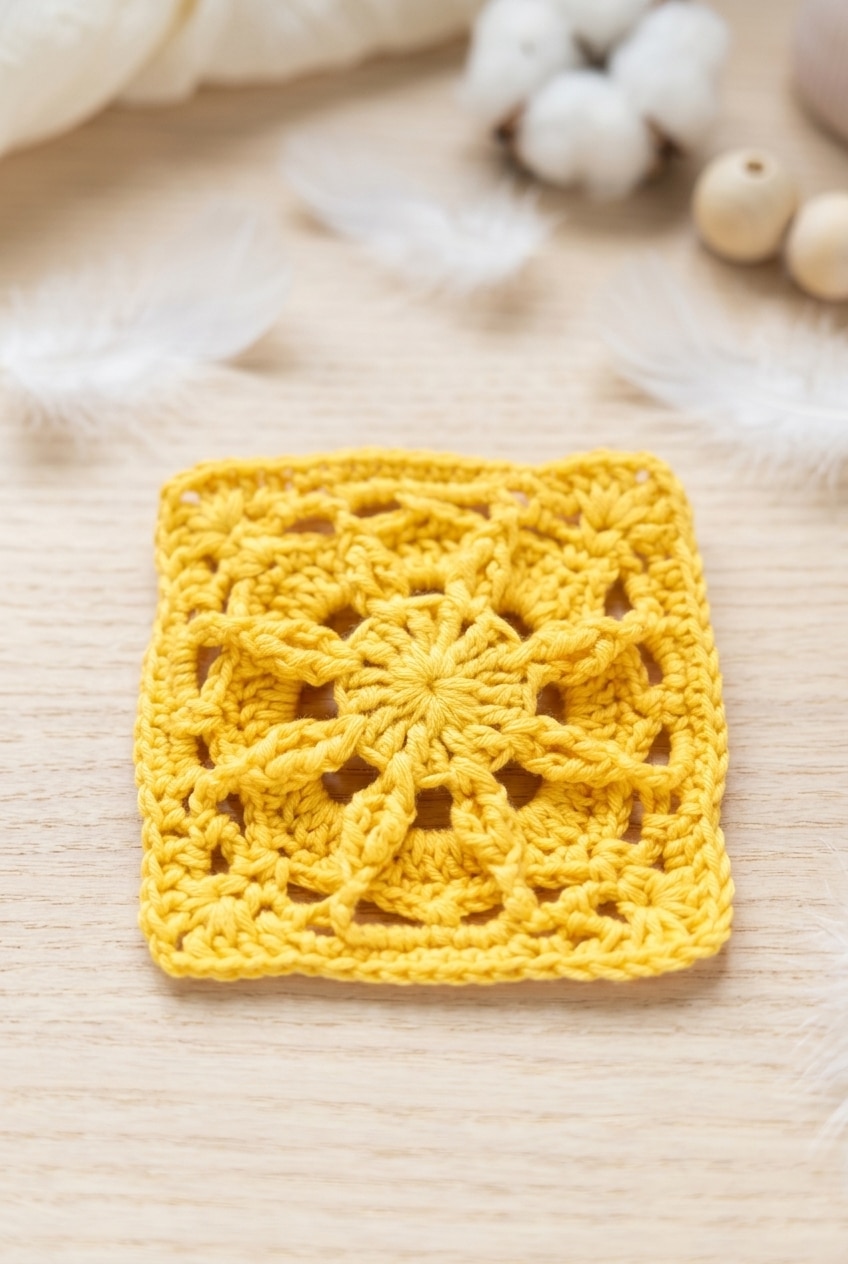
This intermediate-level pattern creates a compact, textured square that works up quickly. It is designed to be flexible, allowing you to use various yarn weights and hook sizes to achieve the fabric density you prefer. The construction relies on a starburst center that expands outward, utilizing specific stitch techniques to create a structured, dimensional look.
Materials
- Yarn: DK Weight Yarn (Any DK weight works; fiber content is up to you). You will need approximately 50 to 100 yards, depending on your desired finished size and hook choice.
- Hook: 2.5 mm Crochet Hook (Recommended for tight, even stitches, though any hook size can be used).
- Notions: Yarn needle, scissors.
Gauge and Finished Size
Gauge is not critical for this project. You can choose a hook and yarn combination that gives you a fabric you like. The estimated finished size is approximately 5.5 inches (14 cm) square when worked with DK yarn and a 2.5 mm hook.
Abbreviations
All abbreviations are US terms.
ch= chainch sp= chain spacedc= double crochetdccl= double crochet cluster (2-dc cluster)dcfps= double crochet front post stitchhdc= half double crochetsc= single crochetsl st= slip stitchst(s)= stitch(es)st sp= stitch space (gap below stitch)tr= treble crochettr2tog= treble crochet 2 together
Special Stitches
- Double crochet cluster (2-dc cluster) (
dccl): Yo, insert hook in indicated st/sp, yo and pull up a loop, yo and pull through 2 loops (2 loops on hook). Yo, insert hook in same st/sp, yo and pull up a loop, yo and pull through 2 loops (3 loops on hook). Yo and pull through all loops on hook. - Double crochet front post stitch (
dcfps): Yo, insert hook from front to back to front around the indicated post(s), yo and pull up a loop, yo and pull through 2 loops, yo and pull through 2 loops. - Treble crochet 2 together (
tr2tog): Yo twice, insert hook around first indicated post, yo and pull up a loop, (yo and pull through 2 loops) twice (2 loops on hook). Yo twice, insert hook around second indicated post, yo and pull up a loop, (yo and pull through 2 loops) twice (3 loops on hook). Yo and pull through all loops on hook.
Pattern Notes
- This square is worked in rounds from a starting loop, building up one layer at a time.
- The
dcclstitches are essential for the structure; practice one before starting Round 2. - Front post stitches and decreases work around posts from previous rounds, so keep tension consistent.
Pattern Instructions
Work through each round in order. The square builds itself up from the center out, with each round adding a new layer of texture and structure.
Round 1
Ch 4 and join to form a loop. Ch 3 (counts as tr), work 15 tr into the loop, sl st in first tr to join. [16 tr]
The starting ch 4 loop gives you a tight, clean center to work all 16 trebles into — pull the tail snug before joining.
Round 2
Ch 3, 1 dc in st sp below, *skip next 2 dc posts, ch 5, 1 dccl in next st sp* repeat from * to * until end, ch 5, sl st in 1st dc to join.
The stitch spaces between posts are where you’re working here, not into the tops of the trebles themselves — keep that distinction in mind as you move around the round.
Round 3
*Sl st over to next ch 5 sp, [ch 3, 4 dc, ch 3, sl st] in same ch 5 sp, sl st in previous dccl* repeat from * to * until end.
Each ch-5 space from Round 2 gets its own little petal cluster here. The sl st into the previous dccl anchors each petal before you move to the next.
Round 4
*1 sc in next ch 3 sp, 1 sc in next 2 sts, ch 2, 1 sc in next 2 sts, 1 sc in next ch 3 sp, tr2tog over previous 2 dccl* repeat from * to * until end, sl st in first sc to join.
The tr2tog is worked over the two dccl posts from Round 2, pulling those earlier stitches into the current round. Make sure you’re reaching back to the correct posts before closing the decrease.
Round 5
Sl st up to ch 2 sp, *[1 sc, ch 2, 1 sc] in ch 2 sp, ch 5, 1 dcfps around previous tr2tog, ch 5, 1 sc in next ch 2 sp, ch 5, 1 dcfps around previous tr2tog, ch 5* repeat from * to * until end, sl st in same beginning ch 2 sp to join.
The front post double crochets wrap around the tr2tog posts from Round 4, so you’re working around the post rather than into the top. The ch-5 chains on either side of each dcfps create the open framework that Round 6 will fill in.
Round 6
*2 dccl in next ch 2 sp (for the first repeat this will be the same ch 2 sp as your previous sl st), ch 3, 1 sc in next ch 5 sp, ch 3, 3 sc in next ch 5 sp, 1 sc in previous sc, 3 sc in next ch 5 sp, ch 3, 1 sc in next ch 5 sp, ch 3* repeat from * to * until end, sl st in previous dccl to join.
The note about the first repeat using the same ch 2 sp as your sl st is easy to miss — don’t skip ahead to the next sp or your stitch count will be off for the rest of the round.
Round 7
[ch 3, 2 dc, ch 2, 3 dc] in same previous dccl, *1 dc in next ch 3 sp, 1 sc in next ch 3 sp, 1 sc in next 7 sts, 1 sc in next ch 3 sp, 1 dc in next ch 3 sp, [3 dc, ch 2, 3 dc] in previous dccl* repeat from * to * until end, ending on 1 dc in last ch 3 sp, sl st in top of ch 3 to join.
The [3 dc, ch 2, 3 dc] clusters form the four corners of the square, and the sc sections along each side fill in the edges between them. Count your 7 sc across each side carefully before working the next corner cluster.
Fasten off and tie in all tails.
Assembly
As this is a single motif pattern, assembly involves weaving in your ends securely. If you plan to join this square into a larger project, such as a blanket or Sunset Ombre Granny Square Baby Romper, follow your preferred joining method (whip stitch, slip stitch, or crochet seam) while the edges are flat.
Tips
- Flexibility: Hook and yarn choice are genuinely flexible here. Any weight, any fiber, any hook size. The size listed is just an estimate based on DK yarn with a 2.5 mm hook. Your square will come out smaller or larger depending on what you use, and that’s fine.
- Tension: The front post stitches and the
tr2togboth work around posts from previous rounds, so it helps to keep your tension fairly consistent as you go. Loose stitches can make the post work a little sloppy.
Frequently Asked Questions
What does dccl mean in this pattern?
Dccl stands for double crochet cluster. You work multiple double crochets into the same space and pull through all loops at once to create a gathered, raised stitch. In this square, the dccl stitches are load-bearing — the star points and corner structure both depend on them sitting correctly.
Can I use a different hook size or yarn weight?
Yes, and the pattern is actually designed with that flexibility in mind. You can work this with any hook and any yarn. The finished size will just shift depending on what you use. Going up to a 4 mm hook with a chunkier yarn would give you a noticeably larger motif.
What is a dcfps and where does it show up?
Dcfps stands for double crochet front post stitch. You insert your hook around the post of the stitch below rather than through the top loops. It comes up in Round 5, worked around the tr2tog stitches from Round 4. Those front post stitches are what give the star its raised, dimensional look.
The center ring feels loose after Round 1. Is that normal?
It is at that stage, yes. Round 1 is just 16 treble crochets worked into a starting loop, and the ring can look a bit open before you close it with the slip stitch. Once you pull the tail to tighten the initial loop and work into Round 2, it firms up considerably. Leave the tail end a little long so you have something to pull on.
How many squares do I need to make a full blanket?
The pattern doesn’t specify a project count since it’s written as a single motif. At roughly 5.5 inches per square with DK yarn, you’d need about 48 squares for a throw-sized blanket around 33 by 44 inches. That’s just a rough calculation though. Lay out a few finished squares to see how they join before committing to a number.
Pin This Crochet Pattern!